Pest Control · LONDON
Commercial Pest Control Contracts for London Businesses: Protecting Premises from Soho Kitchens to Croydon Warehouses
A head chef in a Soho kitchen spots a rodent during service, or a logistics manager in a Croydon warehouse finds gnawed cabling that halts a...

A head chef in a Soho kitchen spots a rodent during service, or a logistics manager in a Croydon warehouse finds gnawed cabling that halts a dispatch. These aren’t just hygiene issues; they are legal and financial risks that can lead to immediate health department closures. Professional commercial pest control contracts London businesses utilise are designed to prevent these disasters. These agreements provide a clinical, proactive framework that keeps your premises compliant with the Food Safety Act 1990 whilst ensuring total discretion.
It’s frustrating to deal with service agreements that feel like a list of hidden costs rather than a genuine shield for your reputation. You want the security of knowing your site is protected without having to chase an administrator for a technician’s report. This guide will show you how to evaluate and select the right pest management agreement to ensure your business remains compliant and permanently pest-free. We will look at the impact of the 2026 CRRU rodenticide regulations and how Integrated Pest Management (IPM) provides a professional standard that amateur fixes simply cannot match.
Key Takeaways
- Understand why London’s interconnected urban landscape, from the Victorian foundations of Camden to the dense commercial rows of Fulham, requires a proactive rather than reactive approach.
- Learn to evaluate commercial pest control contracts London providers offer by matching visit frequencies and pest coverage to your specific industry risks.
- Discover how professional technicians navigate unique city hurdles, such as Soho’s restricted parking and the Congestion Charge, to ensure your service remains uninterrupted.
- Identify the structural vulnerabilities common in ageing London properties and how a clinical mapping process prevents minor sightings from becoming full-scale infestations.
Why London Businesses Require Structured Pest Management Agreements
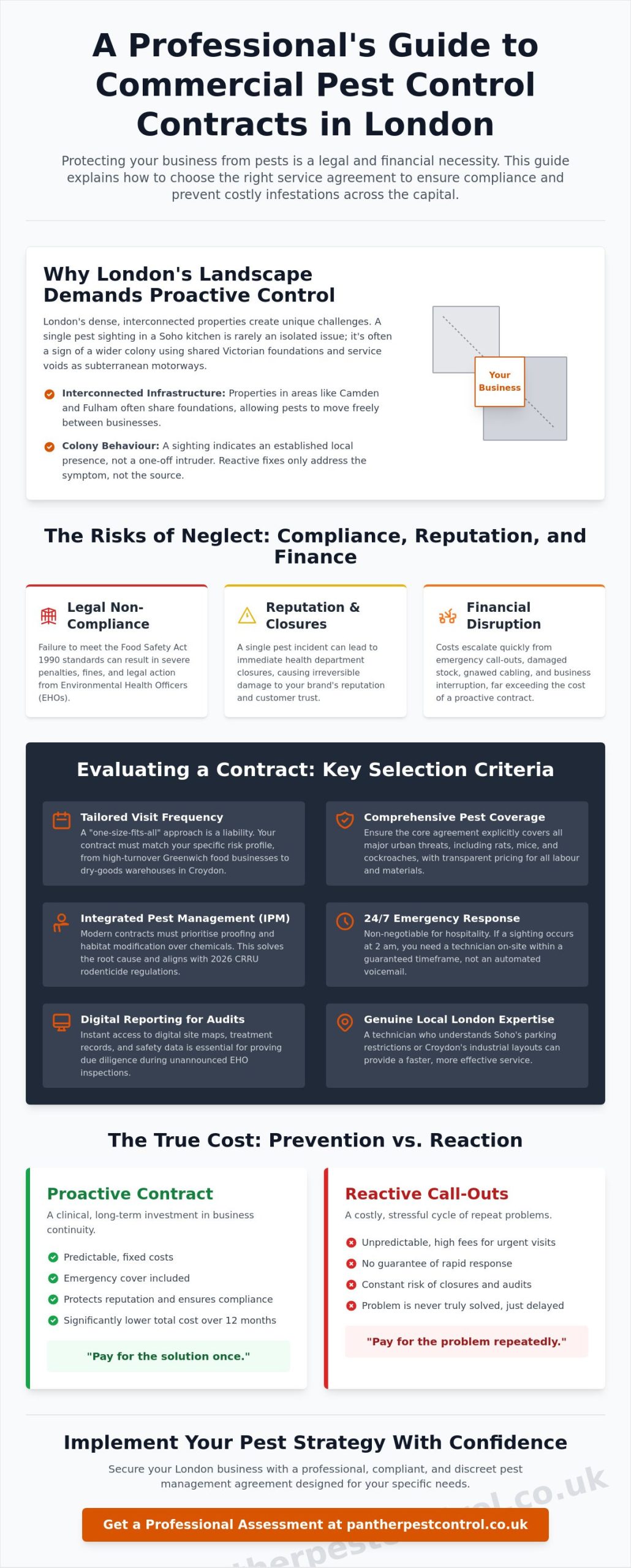
London’s commercial landscape is uniquely vulnerable due to its dense, interconnected nature. In areas like Camden or Fulham, businesses often share Victorian-era foundations and service voids that act as subterranean motorways for rodents. A single sighting in a Soho basement is rarely an isolated incident; our technicians usually find it’s part of a wider local colony. Without the framework of commercial pest control contracts London businesses risk becoming the weak link in their street’s hygiene chain.
To better understand the components of a professional service, watch this helpful video:
This proactive approach is built on a robust Integrated Pest Management (IPM) strategy. It moves beyond simply laying bait to identifying the structural flaws in ageing buildings before a minor entry point becomes a full-blown infestation. Regular monitoring provides the clinical evidence of due diligence required by Environmental Health Officers (EHOs) during unannounced inspections.
Navigating Compliance and Health & Safety Audits
Health department closures are a constant threat for London hospitality venues. Detailed reporting ensures your site meets the Food Safety Act 1990 and other UK legislative requirements. This professional documentation acts as a critical safeguard for your brand’s reputation amongst the city’s competitive hospitality sector. For a deeper look at compliance and professional standards, we recommend reviewing our commercial pest control documentation requirements.
The Long-Term Value of Prevention vs. Reactive Treatments
Many business owners underestimate the total cost of emergency call-outs. Relying on reactive mice control often costs significantly more over a twelve-month period than a structured preventive agreement. Contracts provide financial predictability by including emergency cover. This ensures a rapid response to sightings whilst avoiding the premium fees usually associated with one-off urgent visits. It is a clinical choice: pay for the solution once, or pay for the problem repeatedly.
Evaluating a Commercial Pest Contract: Selection Criteria
Selecting a service agreement shouldn’t be a generic exercise. The frequency of visits must be dictated by your specific operational risk. A high-turnover food business in Greenwich requires far more scrutiny than a dry-goods warehouse in Croydon. Professional commercial pest control contracts London providers offer will tailor the inspection schedule to match these variables rather than applying a “one-size-fits-all” model that often leaves gaps in protection.
Check the scope of coverage carefully. Ensure the core agreement includes all major urban threats, specifically rat control and cockroach management. You need absolute transparency on pricing. A reliable contract covers both technical labour and the materials used during routine checks. It should also provide digital reporting. Instant access to site maps and treatment history is essential for proving compliance during audits under the Food Safety Act 1990.
Essential Contract Inclusions: Beyond the Basics
Look for Integrated Pest Management (IPM) strategies. These prioritise proofing and habitat modification over the lazy, repetitive application of chemicals. This approach solves the root cause rather than just masking symptoms. For businesses like nightclubs or late-night eateries, a guaranteed 24/7 emergency response is non-negotiable. If a sighting occurs at 2 am, you need a technician on-site, not an automated voicemail.
Assessing Technical Expertise and Local Knowledge
Local expertise is a practical advantage. A technician familiar with the specific layouts of Croydon industrial estates will identify entry points faster than an operative based outside the city. Accreditation from the British Pest Control Association (BPCA) is a baseline requirement. It ensures the service meets stringent UK professional standards. If you are unsure which level of cover fits your premises, you can request a site-specific assessment to clarify your requirements.
Implementing Your Pest Strategy with Panther Pest Control
Effective management begins with a forensic assessment of your site. Panther technicians conduct a comprehensive pest inspection to map your property’s specific vulnerabilities, from broken airbricks to poorly sealed loading bays. Under the Prevention of Damage by Pests Act 1949, businesses have a clear legal duty to keep their premises free from infestations. We ensure this duty is met whilst managing the logistical friction of the capital.
We understand that commercial pest control contracts London relies on must account for the city’s unique constraints. Our team manages everything from Congestion Charge zones to the nightmare of securing parking near restricted Soho back-alleys. For sensitive locations like boutique hotels or high-end offices, we maintain a clinical level of discretion. We often arrive in unmarked vehicles to ensure your pest management remains a private matter between us and your facilities team.
Consider a recent project we managed for a restaurant in Fulham. The site required an intensive cockroach treatment, but the business couldn’t afford any downtime. We coordinated our visits during the early hours, arriving at 3 am to complete the work. This ensured zero impact on their morning prep and provided a completely sterile environment before the first customer arrived. It’s this level of service reality that distinguishes a professional contract from a basic call-out service.
Digital Reporting and Proactive Monitoring
Transparency is the backbone of our service. Our digital portals provide real-time updates, making it easy to track mice removal London progress across multiple sites from a single dashboard. We don’t just kill pests; we stop them from coming back. This includes providing clear, actionable advice on structural proofing, such as stopping rats climbing drainpipes to prevent re-entry.
Flexible Agreements Tailored to London Businesses
Your risk level changes based on your industry and location. We scale our agreements to match your actual needs, whether you’re a small independent café or a large-scale logistics centre. For businesses where chemical-free eradication is preferred or required by specific audits, Panther offers specialised options like heat treatment. This provides a decisive, high-temperature solution that eliminates pests in a single visit without the need for prolonged baiting programmes.
Securing Your Business Reputation and Compliance
London’s high-density commercial landscape leaves no room for reactive, amateur fixes. Whether you are managing a boutique hotel in the West End or a distribution hub in Croydon, the risks of visible pests and audit failures are too high to ignore. Professional commercial pest control contracts London businesses rely on provide the clinical, documented proof of due diligence that health officers expect. By prioritising an Integrated Pest Management strategy, you address structural vulnerabilities before they become financial liabilities.
Our BPCA certified technicians deliver 24/7 emergency response across the M25, ensuring that urgent sightings don’t escalate into closures. We provide transparent, audit-ready digital reporting so your treatment history is always accessible during unannounced inspections. Don’t wait for a sighting to compromise your operations. You can Request a Professional Site Survey for Your London Business to establish a permanent shield for your premises. Taking this step today ensures your focus remains on your customers, not on pests.
Frequently Asked Questions
What is typically included in a commercial pest control contract in London?
A professional agreement includes scheduled inspections, emergency call-outs, and the maintenance of monitoring stations for rodents and insects. It also provides audit-ready digital reporting and proactive proofing advice to meet UK legislative requirements. Every visit is documented to ensure you have a clinical trail of due diligence for health inspections.
How much does a commercial pest control contract cost for a small business?
Industry data from June 2026 indicates that commercial pest control contracts London small businesses utilise often range from £50 to £150 per month. For medium-sized sites like restaurants or warehouses, the cost typically sits between £100 and £300. These industry averages depend on the size of your premises and the specific pest risks identified during the initial survey.
How often will a pest control technician visit my premises?
The frequency of visits is dictated by the nature of your business and its location. High-risk food handling sites in Soho or Greenwich usually require monthly or bi-monthly inspections to maintain safety standards. Low-risk environments, such as dry-storage warehouses in Croydon, may only need quarterly visits to ensure the perimeter remains secure.
Are pest control contracts a legal requirement for London restaurants?
The Food Safety Act 1990 doesn’t explicitly mandate a contract, but it does require businesses to have an effective pest management strategy. A structured agreement is the standard method for proving you are taking all reasonable precautions to prevent contamination. Without this documentation, passing an unannounced Environmental Health Officer inspection becomes significantly more difficult.
Can I get a contract that covers multiple business locations across London?
Yes, we can organise a unified agreement that covers multiple sites across the city. This is particularly useful for chains with branches in Camden, Hackney, and Fulham, as it allows for centralised billing and reporting. You can track the status of every location through a single digital portal, ensuring consistent standards across your entire operation.
What happens if a pest problem occurs between scheduled contract visits?
Professional contracts include emergency response cover to address sightings between routine inspections. If a member of staff reports a rodent or an insect issue, a technician is dispatched to investigate and resolve the problem. This rapid intervention prevents a minor sighting from developing into a full-scale infestation that could threaten your business continuity.

Al Joel is a practical writer and long-term property maintenance specialist who focuses on real-world pest control, home safety, and prevention advice. His blog posts are written in a clear, no-nonsense style, based on hands-on experience rather than theory. Al’s goal is simple: to help homeowners make safe, informed decisions and know when DIY is reasonable and when professional help is the smarter option.