Pest Control · LONDON
How to Stop Rats Climbing Drainpipes: A Professional London Proofing Guide
Last week, we visited a terrace house in Islington where the owner was losing sleep to frantic scratching sounds in his ceiling. He'd spent a fortune...
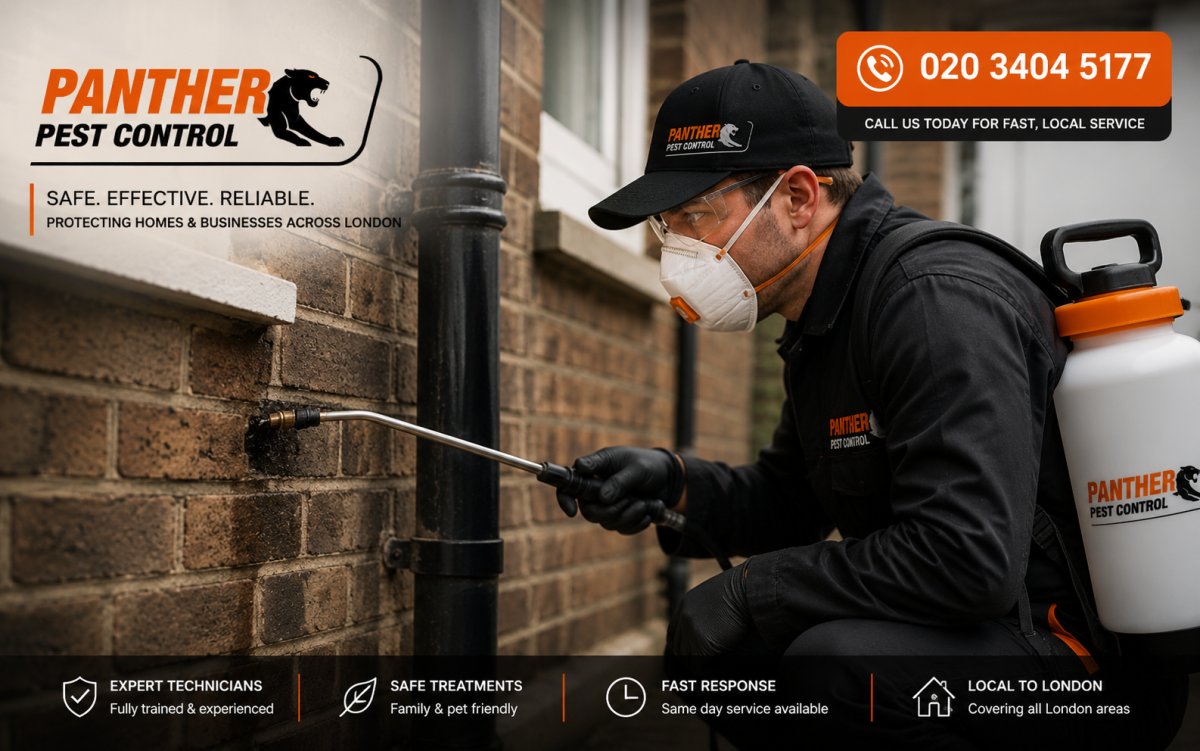
Last week, we visited a terrace house in Islington where the owner was losing sleep to frantic scratching sounds in his ceiling. He’d spent a fortune on DIY traps and retail poisons, but the rats weren’t interested. They weren’t even living on the ground floor. Instead, they were using the external cast iron downpipes as a vertical motorway to reach the loft. It’s a classic London scenario where property age and design make it far too easy for rodents to bypass traditional defences.
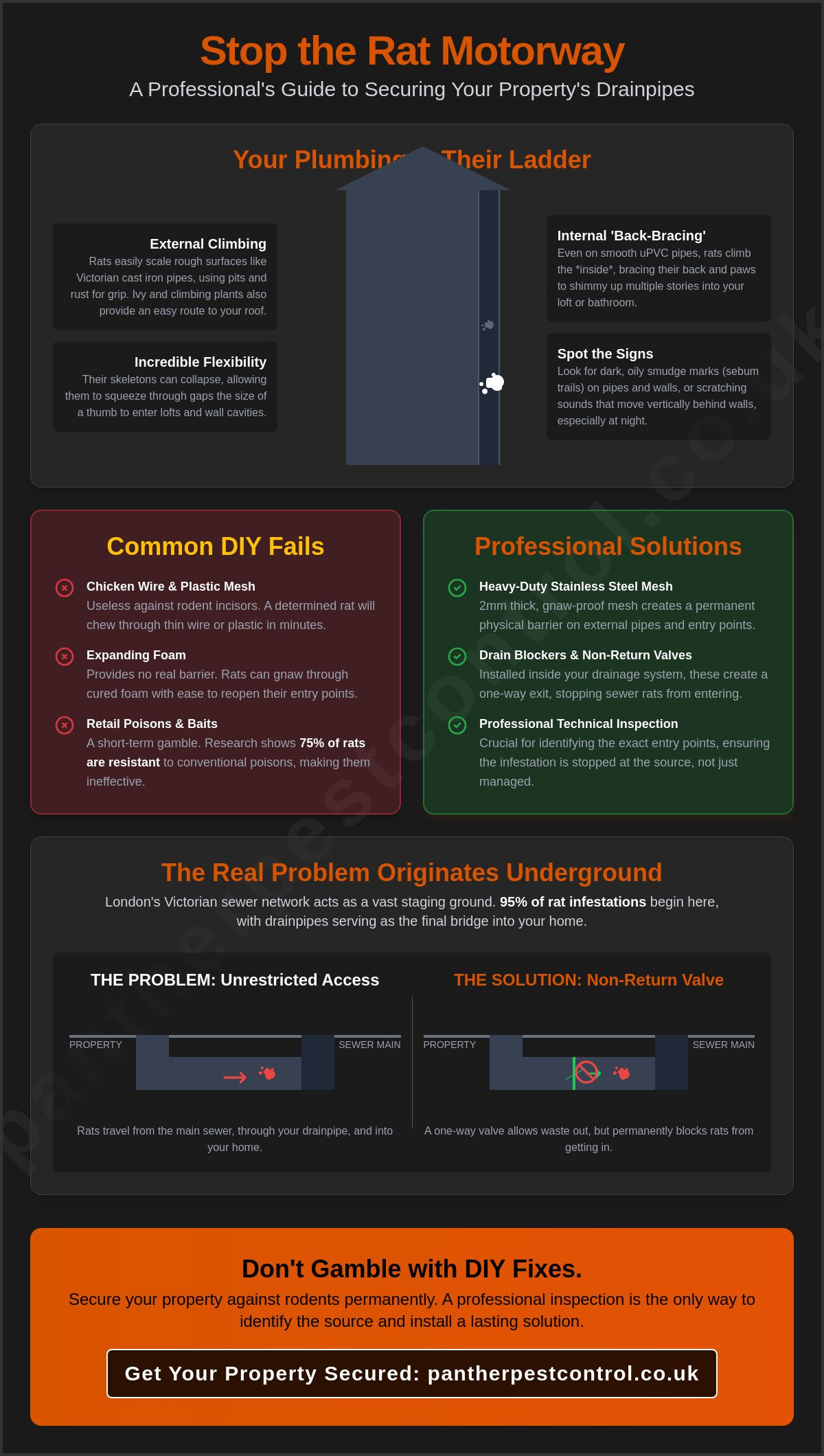
You likely recognise that poison is a short-term gamble, particularly since research shows 75% of rats are now resistant to conventional baits. You need a permanent physical barrier, not a recurring chemical expense. This guide explains how to stop rats climbing drainpipes by using the same professional methods we use to secure properties across the capital. We’ll walk through the installation of stainless steel blockers and explain why these one-way valves are the only way to stop the source of 95% of infestations properly, not temporarily.
Key Takeaways
- Understand how rats use back-bracing and internal pressure to scale vertical pipes, proving that even smooth surfaces aren’t a guaranteed deterrent.
- Discover how to stop rats climbing drainpipes by installing a professional-grade non-return valve that creates a permanent, one-way barrier in your drainage system.
- Learn why heavy-duty stainless steel mesh is the only effective external barrier, as standard chicken wire or plastic covers are easily destroyed by rodent teeth.
- Recognise why identifying the primary entry point is more critical than setting traps, ensuring you stop the infestation at the source properly.
- See why DIY “quick fixes” like expanding foam fail in London properties and how a technical inspection provides a long-term solution.
Why Rats View Your Drainpipes as Vertical Motorways
The brown rat is a far more capable athlete than most Londoners realise. Their skeletal structure allows them to collapse their ribcages to fit through gaps the size of a thumb, whilst their powerful hind legs provide the torque needed for vertical ascents. Whilst the black rat is traditionally known as agile and fast climbers, the common brown rats we deal with across the capital have adapted perfectly to our city’s vertical architecture. This is about long-term prevention, not quick fixes.
To better understand this concept, watch this helpful video:
Many homeowners assume that a smooth uPVC or cast iron pipe is an impossible obstacle. They’re wrong. Rats don’t just climb the outside; they often scale the interior using a technique called back-bracing. By pressing their muscular backs against one side of the pipe and their paws against the other, they create enough internal pressure to shimmy up several stories in seconds. This isn’t guesswork; it’s a documented behaviour that explains why infestations often start in the loft rather than the kitchen.
London’s Victorian sewer network acts as a vast, underground staging ground for these invasions. With 95% of rat problems originating in the sewers, your drainpipes are the primary bridges into your living space. Over time, these pipes accumulate a layer of “urban grip” consisting of grease, limescale, and grime. In areas like Camden, where old drainage systems struggle with heavy use, this build-up provides the perfect traction for a rodent’s claws. Learning how to stop rats climbing drainpipes starts with acknowledging that your plumbing is essentially a ladder for a determined rodent.
London Property Vulnerabilities: Victorian vs. Modern
In older parts of London, such as Fulham or Hackney, Victorian cast iron downpipes are a technician’s nightmare. The rusted, pitted surface of the metal is as easy for a rat to scale as a brick wall. Because these houses are often terraced, a single entry point in one property can lead to a shared loft space, potentially infesting five or six homes at once. Modern plastic stacks aren’t immune either. Whilst they are smoother, the internal accumulation of limescale creates a textured surface that allows rats to reach upper-floor bathrooms with ease. This is why a professional pest inspection is vital to identify which specific pipe is being exploited.
Signs Rats are Scaling Your Pipework Right Now
If you suspect you have a problem, look for sebum trails. These are dark, oily smudge marks left by the grease in a rat’s fur as it repeatedly brushes against a pipe or hopper head. You might also hear scratching sounds that move vertically behind your bathroom walls, specifically after dark. We recently handled a job in a top-floor flat in Greenwich where the resident found droppings in the high-level gutters. The rats were using the external downpipe to bypass the lower floors entirely, entering through a gap in the eaves that was invisible from the ground. This required a permanent physical barrier, not another round of poison.
Installing Physical Barriers: How to Block the Climbing Route
External pipework is the most visible vulnerability on a London property. Whilst internal drain blockers stop rats coming from the sewers, external barriers are your first line of defence against rats that are already in your garden or alleyway. Understanding how to stop rats climbing drainpipes requires a “Done Properly” mindset. This means using materials that can withstand constant gnawing and London’s unpredictable weather.
We often find DIY attempts using chicken wire or thin plastic mesh. These are useless against rodent incisors. A determined rat will chew through thin gauge wire in minutes to regain access to its nesting site. Professional proofing involves 2mm thick stainless steel mesh or purpose-made guards. This follows established UC IPM rat-proofing guidelines for structural exclusion, which prioritise physical barriers over temporary deterrents.
Climbing plants like ivy are another major security risk. Whilst they look attractive on a Victorian facade, they provide a textured ladder that bypasses any smooth pipe surface. If you have dense ivy growing near your downpipes, no amount of pipe proofing will work until the vegetation is cut back at least 12 inches from the stack. If you’re unsure where to start, you can speak directly to a technician about a site survey.
Rat Guards, Cones, and Baffles
Downward-facing cones are highly effective because they break the “back-bracing” rhythm. When a rat hits the underside of a metal cone, it can’t reach around the edge to continue its ascent. These must be placed at least 3 feet from the ground. If they’re too low, a rat will simply jump over them. We always use stainless steel guards; plastic versions are frequently destroyed by rats trying to bypass the obstruction. This is about long-term prevention, not a quick fix that needs replacing in six months.
Anti-Climb Paint and Perimeter Security
Anti-climb paint is often suggested, but its effectiveness against rodents is limited. It stays slippery for a while, but once it’s covered in London dust and grime, rats can often find enough purchase to scale it. A better focus is the “Hopper Head” at the top of the pipe. This is the wide opening where the pipe meets the gutter. We seal these with custom-cut steel mesh to ensure that even if a rat scales the brickwork, it cannot enter the roofline.
In a Fulham terrace we recently inspected, the owner had installed pipe guards but still had rats in the loft. The rodents were using a decorative wooden trellis just two inches away to bypass the guard entirely. This highlights why a professional rat control strategy looks at the whole property, not just the pipes. We ended up moving the trellis and securing the hopper heads to solve the problem properly.
Securing the Source: Drain Blockers and Non-Return Valves
Stopping the problem at the pipe’s base is often more effective than trying to catch them at the roofline. A non-return valve, or rat blocker, acts as a security gate for your plumbing. It uses a stainless steel flap that allows water and waste to exit your property freely but prevents anything from swimming or climbing back up. This “one-way street” logic is the most reliable answer to how to stop rats climbing drainpipes because it secures the source before they ever reach the vertical climb.
Basements and ground-floor flats in areas like Kensington or Marylebone are particularly vulnerable to rats entering via the toilet. Whilst the thought is distressing, the solution is purely mechanical. We avoid the plastic valves sold in retail shops; rats can easily gnaw through thin plastic to bypass the barrier. We only install high-grade, twin-flap stainless steel blockers that are guaranteed to withstand rodent teeth and the harsh environment of a London sewer.
If you’re tired of temporary fixes that don’t address the root cause, contact our technicians to discuss a permanent drain blocker installation.
Fitting a Non-Return Valve Properly
Locating the inspection chamber is the first step in professional rat control. In many London homes, these manholes are hidden under newer extensions or garden decking. If a valve is fitted incorrectly, it can snag debris and lead to fatbergs. This is a recurring issue in Camden where grease build-up in the system is high. A blocked drain is a secondary crisis you want to avoid; professional installation ensures the flap moves freely without snagging waste or causing a backup.
Sealing the “Gully Pot” and External Grates
Rats often escape the main pipe through cracks in the manhole benching, which is the sloped concrete at the bottom of the chamber. Once they’re in the void under your floorboards, they’ll find any gap to enter the house. We replace loose, lightweight gully grates with heavy-duty, bolt-down versions. This stops rats from simply lifting the lid to escape. Sealing the gap where the pipe enters the house wall with sand and cement is a final, essential step to ensure the barrier is complete.
Professional Proofing: Why a Proper Inspection is Essential
Many Londoners reach for a can of expanding foam the moment they find a gap around a pipe. It’s a common mistake. Rats have incisors capable of gnawing through lead, aluminium, and wood; a bit of aerated plastic won’t stop them for more than a few minutes. This is a temporary patch, not a long-term solution. Proper proofing requires identifying the primary entry point rather than just reacting to the symptoms of an infestation. The same structural vulnerabilities that allow rats to exploit your drainpipes can also allow mice to infiltrate your kitchen; professional mouse proofing kitchen London services use the same permanent exclusion principles to seal the precise gaps that amateur fillers consistently miss.
Our approach focuses on permanent exclusion. If you’re only setting traps in the kitchen, you’re ignoring the vertical motorway in your walls. In extreme cases where an infestation has become deep-seated within the building fabric, we may use heat treatment to eradicate the problem entirely. This works in tandem with physical proofing to ensure your home is restored to a safe, hygienic state properly, not temporarily.
Moving from a state of constant anxiety to a permanently rodent-free property starts with understanding the specific mechanics of your building. Whether it’s a top-floor flat or a basement bedsit, the goal is a physical barrier that removes the need for constant poison use. This is the only way to gain true peace of mind in a city with a rat population as resilient as London’s. London properties face multiple pest pressures simultaneously, and homeowners who resolve their rat problem often discover that the same structural gaps attracting rodents can also lead to summer ant problems in London kitchens, where a 1mm gap in skirting boards is all a colony needs to establish a permanent foraging route.
The Role of CCTV Drain Surveys
A visual inspection of your external pipework only tells half the story. Rats often exploit “hidden faults” such as collapsed clay pipes or displaced joints beneath your floorboards. In older Croydon terraces, subsidence frequently causes these shifts, creating a direct path from the sewer into your wall cavity. Our technician-led CCTV surveys allow us to see exactly what the rodents see. We identify the specific breach in the system, allowing us to implement the right strategy for how to stop rats climbing drainpipes based on hard evidence, not guesswork.
Panther’s “Done Properly” Guarantee
We’ve built our reputation on directness and technical expertise. When you contact us, you speak directly to a technician who knows the local challenges of London’s varied postcodes. We provide a rapid, professional response from Croydon to Greenwich, ensuring that your property is protected by someone who understands the stakes. We don’t use call centres; we use seasoned experts who take pride in workmanship that lasts. Request a professional pest inspection to secure your drainpipes today and restore safety to your home.
Secure Your Home with Permanent Rodent Proofing
Restoring safety to your property requires a shift in strategy. You’ve seen that rats don’t just wander in; they scale your architecture with athletic precision. By installing stainless steel blockers at the source and securing external hopper heads with heavy-duty mesh, you break the cycle of infestation properly. This approach prioritises physical exclusion over the endless cycle of retail poisons that modern rats have largely learned to resist.
Understanding how to stop rats climbing drainpipes is the difference between a quiet night’s sleep and another week of scratching in the ceiling. We’ve completed 20,000+ jobs properly across London, from Victorian terraces to modern apartment blocks. Our local technicians provide a same-day emergency response to ensure your crisis is handled with the urgency it deserves. You’ll speak directly to an expert, not a call centre, ensuring the technical advice you receive is grounded in real-world experience.
Don’t wait for the next scratching sound to take action. Get a professional rat-proofing quote from Panther Pest Control today and secure your property for the long term. We’re ready to help you reclaim your peace of mind.
Common Questions About Rat Proofing Drainpipes
Can rats really climb up a smooth plastic drainpipe?
Yes, rats scale smooth plastic pipes by using internal pressure or back-bracing against the walls. They also find grip on the layer of limescale and grease that builds up inside modern plumbing over time. It’s a common misconception that smooth surfaces are impassable; a determined rodent only needs a few millimetres of texture or a narrow enough diameter to shimmy upwards into your home.
How much does it cost to install a rat blocker in the UK?
Professional installation of a rat blocker in a domestic London property typically costs between £200 and £300 plus VAT. This is a one-time investment for a permanent physical solution. Whilst you can buy basic units online for around £65, these often lack the durability of professional stainless steel models and carry the risk of causing fatbergs if fitted incorrectly by a non-expert.
Will bleach or peppermint oil stop rats in my pipes?
No, bleach and peppermint oil are ineffective deterrents for an established rat problem. These substances wash away almost immediately in a drainage system and do nothing to address the physical entry points. Rats are highly adaptable; they’ll simply wait for the scent to dissipate or find a different route. Real protection requires a mechanical barrier, not a temporary fragrance or household chemical.
Who is responsible for rats in the drains: me, the council, or Thames Water?
You are generally responsible for the drains within your property boundary, whilst Thames Water manages the public sewers. If the infestation is within your private pipework, it’s your duty to arrange proofing. However, if there’s a collapsed public sewer causing the issue, the water company may need to intervene. Learning how to stop rats climbing drainpipes on your own land is the fastest way to resolve the crisis.
Can rats come up through the toilet if I have a drainpipe infestation?
Yes, rats are excellent swimmers and can easily navigate the water in a toilet U-bend. Since most infestations start in the sewer, the toilet is a direct entry point if your drainage isn’t secured with a non-return valve. Installing a professional blocker is the only way to ensure they stay in the sewer system where they belong, rather than entering your bathroom and causing distress.
How do I know if the scratching in my walls is a rat or a squirrel?
Timing is the biggest clue. Rats are nocturnal, so you’ll hear them scratching and scurrying late at night or in the early hours. Squirrels are active during the day, particularly at dawn. You should also check the loft for droppings; rat droppings are dark and spindle-shaped, whilst squirrel droppings are more rounded. A technician-led inspection can confirm the species through sebum marks and entry patterns. If you’ve also noticed activity near your food preparation areas, reviewing a professional checklist of signs of mice in kitchen spaces can help you determine whether a separate rodent issue is developing alongside your rat problem.

Al Joel is a practical writer and long-term property maintenance specialist focused on real-world pest control, home safety and prevention advice. His guides translate common warning signs into clear next steps for homeowners, tenants, landlords and property managers.
His approach begins with correct identification. A sighting in one room may originate from a neighbouring flat, service riser, drainage, roof space, delivery or communal waste area. Al explains how to preserve useful evidence, reduce food and water sources, avoid spreading activity and choose proportionate treatment.
What readers can expect
- Clear identification clues and practical inspection steps
- Safe preparation, cleaning and aftercare guidance
- Prevention advice for homes, flats and commercial premises
- Honest guidance on when DIY is reasonable and when professional help is the smarter option
When professional help makes sense
Repeated sightings, activity in several rooms, uncertain identification, vulnerable occupants or signs involving food, electrics and shared building routes deserve a professional inspection. A lasting solution normally combines targeted treatment with proofing, hygiene and follow-up monitoring.
Explore the Pest Library, learn how treatment works, or request property-specific advice.