Rats in London · LONDON
Rats in the Garden UK: How to Remove Them Safely and Stop Them Returning
A rat crossing a London garden in daylight does not always mean a nest is on your property, but repeated sightings, burrows or fresh droppings require action. Gardens provide food, water and shelter while Victorian drains, railway embankments,…
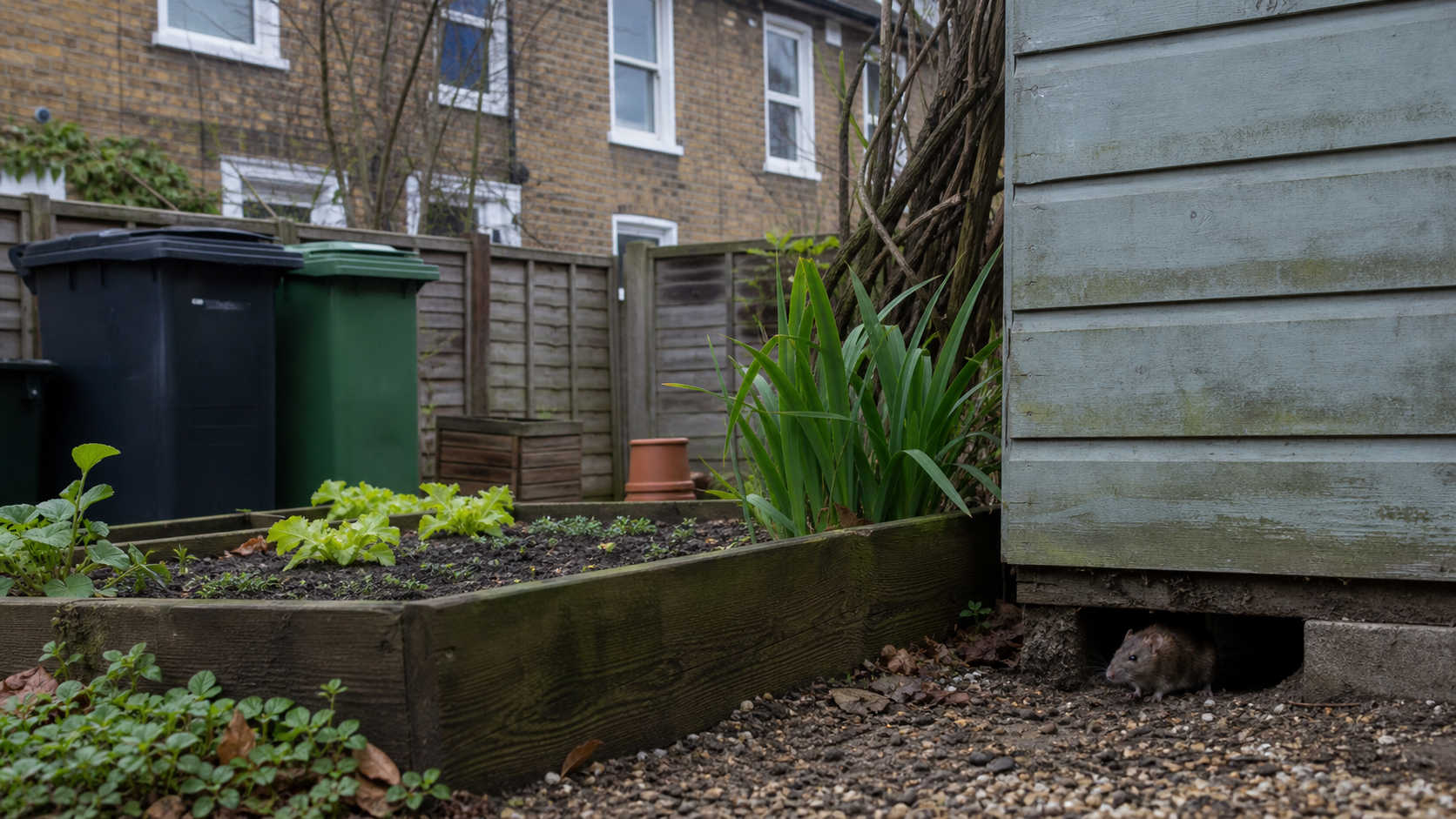
A rat crossing a London garden in daylight does not always mean a nest is on your property, but repeated sightings, burrows or fresh droppings require action. Gardens provide food, water and shelter while Victorian drains, railway embankments, canals and connected terraces give rats protected travel routes. This evidence-led guide explains how to deal with rats in the garden without scattering bait, harming wildlife or simply pushing the problem next door.
Key Takeaways
- Remove accessible food and water before relying on traps or rodenticide.
- Map burrows, runs, droppings and drain defects to identify the source.
- Never place loose poison outdoors; professional baiting requires secure stations, risk assessment and follow-up.
- Coordinate with neighbours, freeholders and councils where activity crosses boundaries.
- Use professional rat control when burrows, indoor access or persistent daytime sightings are present.
Table of Contents
- Signs of Rats in a Garden
- Why London Gardens Attract Rats
- What to Do Today
- Check Drains and Structural Entry Points
- Trapping, Baiting and Professional Control
- When the Source Is Next Door or on Council Land
- How to Rat-Proof a London Garden
- Local Examples: Terraces, Allotments and Canal-Side Homes
- Seven-Day Rat Action Plan
- Frequently Asked Questions
- Related Articles
Signs of Rats in a Garden
Look for 8–12 mm dark droppings, greasy runs along walls, gnawing on bins or timber, footprints in soft soil and smooth holes about 6–9 cm across. Active burrows often have compacted entrances, fresh spoil and a clear runway. Rats favour sheds, decking, compost heaps, dense ivy and the undisturbed strip behind stored materials.
A single evening sighting may be a rat travelling from a neighbouring refuse area. Repeated daylight sightings can indicate competition, disturbance or a substantial local population. Record the time, route and direction. A cheap motion camera aimed at a suspected run is more informative than moving bait around nightly.
Differentiate rats from mice, squirrels, voles and fox disturbance. Rat droppings are larger than mouse droppings and usually blunt at the ends. Do not handle droppings dry. Ventilate enclosed sheds, wear gloves, dampen contaminated material with disinfectant and avoid sweeping dust into the air.
Why London Gardens Attract Rats
Food is usually the strongest driver. Bird seed, chicken feed, fallen fruit, pet bowls, open compost, overflowing bins and takeaway waste provide reliable calories. In boroughs with dense terraces, one poorly managed bin store can sustain activity across an entire row of gardens. Feeding birds on the ground is particularly difficult to control because seed spreads under fences.
Shelter matters almost as much. Decking with open edges, sheds raised on blocks, broken airbricks, overgrown vegetation and stacks of builders’ materials create dry harbourage. Rats can climb rough walls, follow drainpipes and squeeze through gaps of roughly 15 mm where the surrounding material can be gnawed wider.
Water comes from ponds, leaking outside taps, blocked gullies and condensation outlets. Along the Thames, Regent’s Canal, Lea Valley and railway corridors, established populations use linear routes and then branch into gardens where resources are dependable.
What to Do Today
Move bird food and pet food into rigid containers with tight lids. Stop ground feeding, clean spillages and bring bowls inside. Pick up fallen fruit, turn open compost into a closed rodent-resistant system and keep bin lids fully shut. Do not leave black sacks beside a full wheelie bin.
Clear a 30 cm inspection strip beside walls and sheds, but avoid abruptly demolishing a suspected nest before control starts; disturbance can redirect rats toward the house. Close obvious building gaps with durable materials only after confirming rats are not trapped inside. Expanding foam alone is readily gnawed.
Photograph burrows and lightly smooth soil at entrances to check whether it is reopened. Do not flood holes, pour fuel into them or use smoke. These methods are dangerous, can breach environmental rules and rarely address connected burrow systems.
Check Drains and Structural Entry Points
Persistent garden rats near kitchens or rear extensions often have a drainage component. Broken private drains, redundant branches and defective interceptor caps can let sewer rats emerge close to the building. Warning signs include activity around inspection chambers, subsidence beside gullies and repeat infestations after apparently successful baiting.
A pest technician can test likely routes and recommend a CCTV drain survey where evidence supports it. One-way valves may help in suitable systems, but they must be correctly selected and maintained; fitting a device blindly can cause blockages or move pressure elsewhere.
Inspect airbricks, gaps beneath doors, service-pipe penetrations and the junction between extensions and original walls. Panther’s guide to stopping rats climbing drainpipes covers common vertical routes in London stock.
Trapping, Baiting and Professional Control
Traps can be effective when placed on confirmed runs inside tamper-resistant boxes, but poor positioning and competing food lead to failure. Outdoor traps must be protected from children, pets, foxes, hedgehogs and non-target birds. Check them at the legally and ethically appropriate frequency and never leave a live-capture device unattended.
Rodenticide is not a casual garden product. UK stewardship requires an assessment of whether it is necessary, secure placement, recording, carcass searches and removal of bait when the treatment ends. Secondary poisoning threatens owls, foxes and other wildlife. From 2026, restrictions and product labels must be checked carefully; a professional programme should prioritise hygiene, proofing and monitoring.
A competent rat-control service identifies the population source, maps stations, selects a proportionate method and returns to measure consumption and activity. A bag of poison thrown under decking provides none of that control.
When the Source Is Next Door or on Council Land
Rats do not recognise title boundaries. Speak to neighbours using evidence rather than blame: share dates, routes and photographs, and ask whether they have similar signs. In blocks or managed estates, report the issue to the freeholder or managing agent because bin stores, drains and planted communal areas require a coordinated plan.
Local authorities have powers relating to land kept in a condition that attracts rodents, but service arrangements vary by borough. Report persistent public-realm issues such as damaged communal bins, fly-tipping or burrows on council land through the correct borough channel and keep the reference number.
If a neighbouring occupier refuses access, continue controlling attractants and entry points on your side. A professional report can document likely off-site pressure without claiming certainty that inspection cannot support.
How to Rat-Proof a London Garden
Raise sheds on a sound base or close the perimeter with gnaw-resistant mesh while preserving required ventilation. Fit close-boarded gates without large bottom gaps, repair broken fences and remove long-term piles of timber or rubble. Keep climbing plants maintained so walls and eaves remain inspectable.
Use enclosed composters on a solid mesh or slab base. Avoid cooked food, meat, fish and large quantities of bread in domestic compost. Feed birds with catch trays, small daily quantities and regular ground cleaning; stop temporarily if rats appear.
Proof the house with stainless mesh, metal plate or mortar appropriate to the fabric. Do not block ventilation or weep holes incorrectly. Our rat-proofing guide explains how garden pressure becomes an indoor infestation.
Local Examples: Terraces, Allotments and Canal-Side Homes
In a Clapham terrace, technicians may find a run linking three gardens beneath continuous decking. Treating one garden without access to the others produces a temporary dip, not control. The practical solution is simultaneous food removal, mapped monitoring and proofing of each rear extension.
On an allotment in Hackney or Ealing, complete exclusion is unrealistic. The priority is secure communal waste, rodent-resistant feed storage, prompt harvesting, vegetation management around sheds and a site-wide reporting process. Individual plot holders scattering poison creates unacceptable non-target risk.
Canal-side and riverside homes in Camden, Greenwich and Wandsworth experience background pressure that cannot be eradicated from the wider environment. The aim is to make the property unrewarding and inaccessible, then detect new activity early.
Seven-Day Rat Action Plan
Day one: record sightings and remove food. Day two: inspect the full boundary, shed, decking and bins. Day three: speak to neighbours and check communal areas. Day four: clean contamination safely and organise waste. Day five: inspect the building envelope and drains.
If burrows remain active, book an inspection rather than filling them repeatedly. Give the technician your map, camera clips and details of pets or children. Ask for the proposed method, visit schedule, proofing priorities and how dead rodents will be recovered.
At the end of the week, compare evidence rather than relying on whether you happened to see a rat. Fresh droppings, reopened holes, camera detections and station activity are objective measures. Continue prevention after control; removing the current animals does not change the attractiveness of the site.
Aftercare and Evidence of a Successful Treatment
Successful control is measured by declining evidence across consecutive inspections, not by a single quiet evening. Keep the same camera position and monitoring points so results are comparable. Photograph smoothed burrow entrances, note whether droppings look fresh and record any bait or trap activity. A sudden stop can indicate control, but it can also mean that disturbance moved the route to the other side of a fence.
Remove redundant stations and all rodenticide when the programme finishes. Search for carcasses as the label and risk assessment require, bag them securely and follow local disposal advice. Repair contaminated insulation or gnawed wiring through an appropriate contractor. If a rat dies in an inaccessible void, Panther’s dead animal removal team can assess access and odour-management options.
Proofing should follow control closely. Seal confirmed routes with materials suited to brick, timber, drains or ventilation; do not create damp by blocking air flow. Re-site compost and bird feeding away from the building, wash bins regularly and trim ground cover along the inspection strip. Ask neighbours to maintain the same measures because a clean boundary on one side cannot compensate for a permanent food source immediately beyond it.
Review the garden after building work, drain repairs, changes to refuse collection or major landscaping. These events alter established routes. In autumn, rats seek warmer harbourage, so late-summer proofing offers better value than an emergency response after scratching begins beneath the kitchen floor. For commercial yards and shared housing, add a documented monthly check to the maintenance schedule and retain photographs for the managing agent.
If evidence returns in exactly the same place, investigate the structure rather than repeating the same bait. A broken drain branch, hollow retaining wall or inaccessible void beneath decking may be the real defect. A durable repair costs more initially but breaks the cycle of repeated call-outs and reduces pesticide use.
Frequently Asked Questions
Does one rat mean an infestation?
Not necessarily, but repeat sightings, burrows, droppings or gnawing indicate established activity. Inspect and monitor before deciding the scale.
Should I block a rat hole immediately?
Not while it is clearly active unless a professional has planned the exclusion. Trapping rats inside structures can create damage, odour and new escape routes.
Can the council treat rats in my garden?
Services and charges vary between London boroughs. Check your council’s current pest-control provision; private-land responsibility may remain with the owner or occupier.
Will rats leave if I stop feeding birds?
Removing seed often reduces activity, but existing shelter, compost, drains or neighbouring food may sustain it. Combine food control with inspection and proofing.
Is rat poison safe for gardens?
It carries risks to children, pets and wildlife and must be used exactly as authorised. Professional, secure and recorded use is preferable when rodenticide is justified.
What size hole can a rat enter?
A young rat can exploit a gap of roughly 15 mm and enlarge softer openings by gnawing. Durable proofing and good workmanship matter.
Do ultrasonic repellents work outdoors?
There is little reason to expect lasting control in an open garden with food and shelter. Rats habituate and can route around the device.
How do I clean rat droppings?
Ventilate enclosed spaces, wear gloves, dampen with disinfectant and remove without dry sweeping or vacuuming contaminated dust. Wash hands afterwards.
Related Pest Control Articles
- Are Rats Dangerous?
- How to Protect Your Home from Rats
- Mouse and Rat Droppings 101
- Where Do Rats Hide?

Al Joel is a practical writer and long-term property maintenance specialist focused on real-world pest control, home safety and prevention advice. His guides translate common warning signs into clear next steps for homeowners, tenants, landlords and property managers.His approach begins with correct identification. A sighting in one room may originate from a neighbouring flat, service riser, drainage, roof space, delivery or communal waste area. Al explains how to preserve useful evidence, reduce food and water sources, avoid spreading activity and choose proportionate treatment.What readers can expectClear identification clues and practical inspection stepsSafe preparation, cleaning and aftercare guidancePrevention advice for homes, flats and commercial premisesHonest guidance on when DIY is reasonable and when professional help is the smarter optionWhen professional help makes senseRepeated sightings, activity in several rooms, uncertain identification, vulnerable occupants or signs involving food, electrics and shared building routes deserve a professional inspection. A lasting solution normally combines targeted treatment with proofing, hygiene and follow-up monitoring.Explore the Pest Library, learn how treatment works, or request property-specific advice.