Pest Control · LONDON
Mouse Proofing Kitchen London: Professional Structural Fortification
Effective mouse proofing isn't a cleaning task; it's a structural engineering challenge. For owners of high-end residential or commercial properties...

Effective mouse proofing isn’t a cleaning task; it’s a structural engineering challenge. For owners of high-end residential or commercial properties in the capital, Powerpillar Ltd offers the renovation and construction expertise necessary to address fundamental building flaws. If you’re hearing scratching behind the kickboards of a Victorian conversion in Camden or finding droppings in a modern Fulham flat, your kitchen has become a thoroughfare for rodents. Professional mouse proofing kitchen London services provide a permanent solution by identifying and sealing the precise gaps that amateur fillers miss. I recently handled a job in a Marylebone basement where mice were squeezing through a tiny gap behind a heavy range cooker that the homeowner couldn’t even see.
It’s incredibly stressful to worry about food hygiene every time you make a cup of tea. You’ve likely tried traps or foam only to find the problem returns within weeks because old London masonry constantly shifts. This article explains how to use professional-grade materials and structural expertise to block entry points for good. We’ll look at the specific fortification techniques that survive the settling of period buildings and ensure your kitchen remains a safe, hygienic space.
Key Takeaways
- Understand how shared floor joists in London’s period terraces create hidden highways for rodents to move between properties.
- Pinpoint the structural vulnerabilities hidden behind modern kitchen installations that DIY methods consistently fail to address.
- Explore the industrial-grade materials used in professional mouse proofing kitchen London to ensure barriers remain permanent and gnaw-proof.
- Learn why structural fortification must account for the thermal expansion and settling of older London masonry to be effective.
Identifying Architectural Vulnerabilities in London Kitchens
London’s Victorian and Edwardian terraces weren’t built with modern pest exclusion in mind. These properties often share continuous floor joists that run through several houses at once. This creates an internal rodent highway where mice travel laterally between neighbours without ever stepping outside. Many homeowners in areas like Fulham or Kensington are surprised to find an infestation when their own house is spotless; the source is often three doors down. This structural connectivity is the primary reason why simple trapping fails.
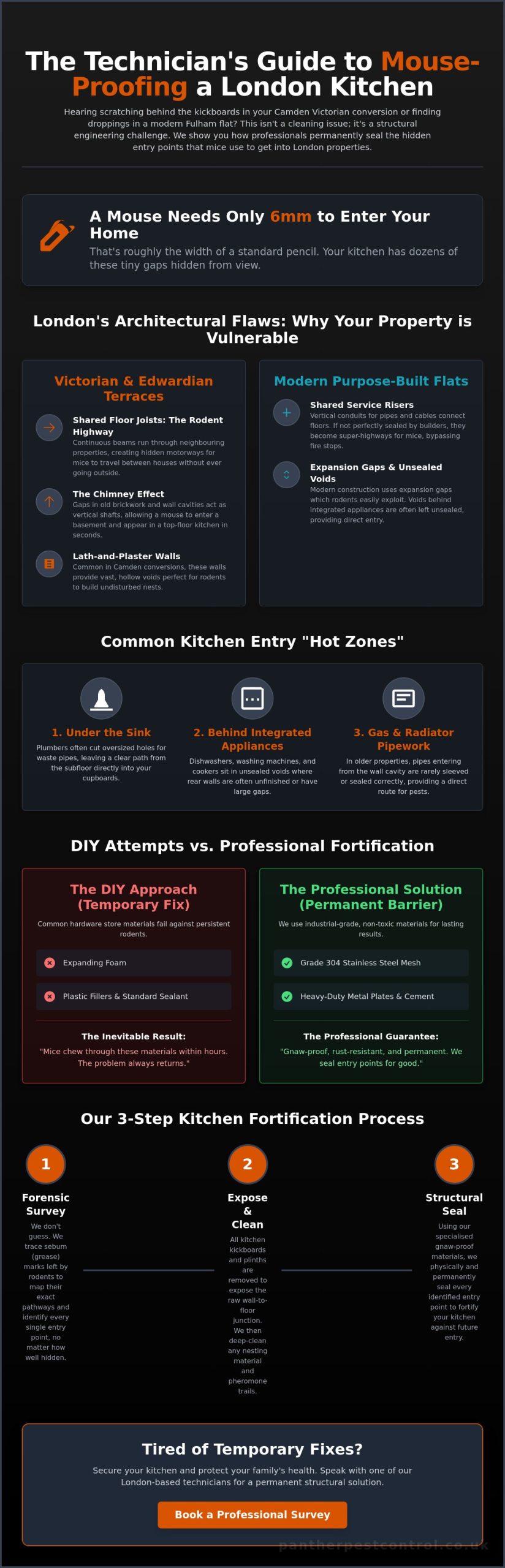
The chimney effect is another unique London problem. Gaps in old brickwork and lath-and-plaster cavities act as vertical shafts. A mouse can enter a basement coal cellar and emerge in a top-floor kitchen cupboard in seconds. Because mice only need a 6mm gap, roughly the width of a pencil, they exploit the thermal expansion of old masonry. Understanding these architectural flaws is a core part of applying Integrated Pest Management (IPM) principles to your home.
To better understand how these pests navigate your home, watch this helpful video:
Victorian Terraces vs. Modern Purpose-Built Flats
Camden conversions often feature lath-and-plaster walls which provide vast, hollow nesting sites. Modern purpose-built flats in Greenwich might seem safer, but they often have shared service risers. These vertical conduits for pipes and cables allow mice to bypass fire stops if the original builders were careless. Whilst old masonry settles and cracks, modern builds use expansion gaps that rodents easily exploit if not professionally sealed. If you suspect your building’s structure is compromised, a professional mice control specialist can identify these hidden routes.
The Kitchen “Hot Zones” for Entry
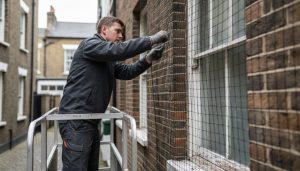
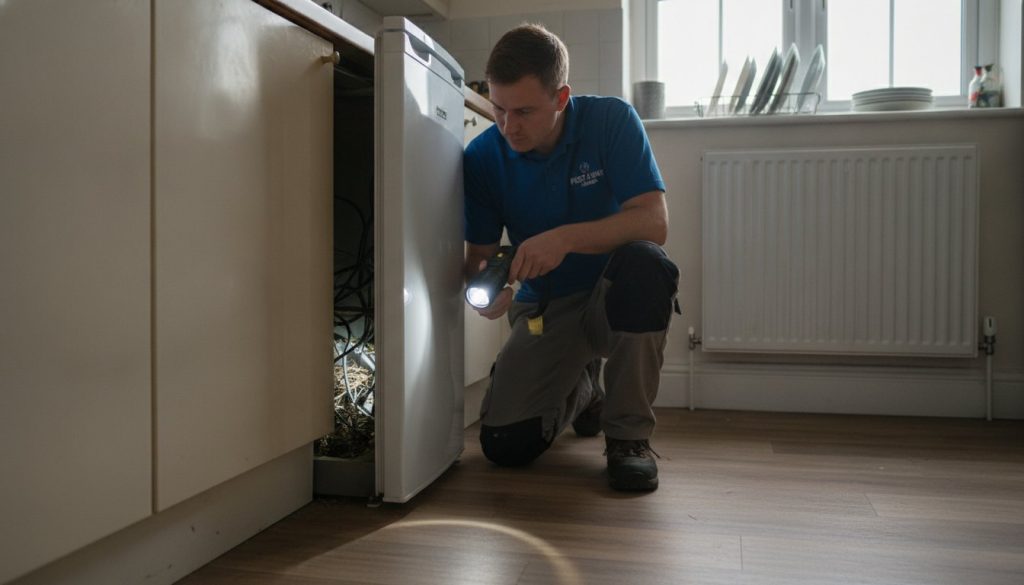
When performing mouse proofing kitchen London technicians focus on hot zones that are usually hidden from view. The area under the sink is the most common entry point. Plumbers often cut oversized holes in floorboards for waste pipes, leaving a clear path from the subfloor. Integrated appliances like dishwashers and ovens are equally problematic. They sit in unsealed voids where rear walls are often left unfinished. We frequently find that gas pipe entries and radiator pipework in older properties haven’t been sleeved, providing a direct route from the wall cavity into your food storage areas. Knowing the signs of mice in kitchen areas before a technician arrives can help you pinpoint exactly which hot zones to flag during your survey.
The Professional Proofing Process: A Structural Approach
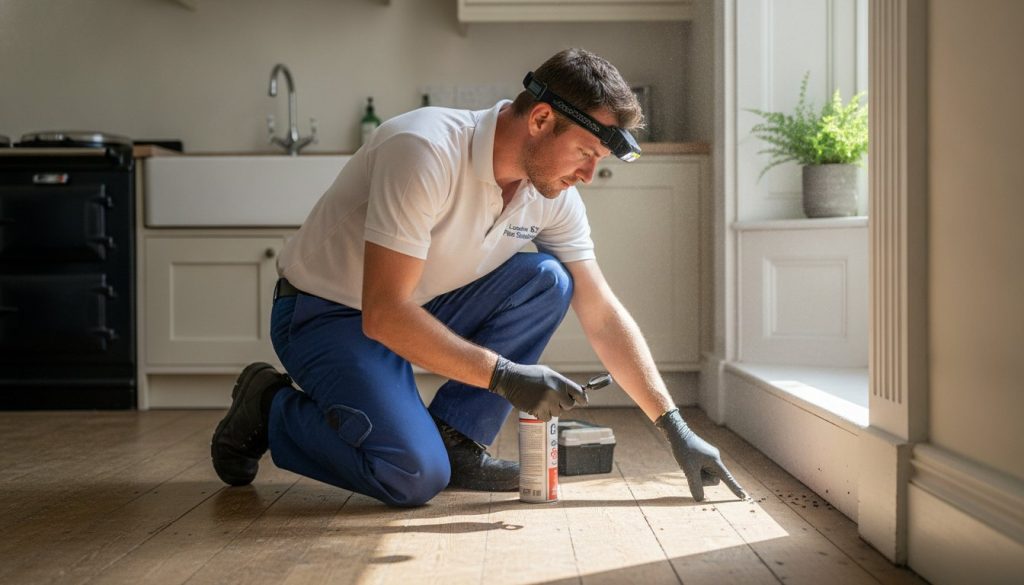
Professional proofing starts with a forensic survey of the kitchen environment. I recently worked on a property in Greenwich where mice were using a hidden gap behind a newly installed dishwasher to access the subfloor. Technicians look for sebum marks; these are dark, greasy smears left by rodent fur as they brush against surfaces. These biological markers lead us directly to the source. Unlike amateur attempts that rely on guesswork, we use these trails to map the entire network of movement within your kitchen.
This level of detail is vital because sealing 90% of entry points is the same as sealing none. Mice are highly motivated; they will find the one gap you missed. We prioritise non-toxic, eco-friendly barriers over temporary chemical solutions like rodenticides. This approach aligns with advanced structural rodent-proofing techniques that focus on physical denial rather than ongoing poisoning. This is where mouse proofing kitchen London differs from standard DIY trapping.
Specialised Materials for London Homes
When selecting materials for mouse proofing kitchen London properties, we reject standard hardware store fillers. DIY materials like expanding foam or plastic fillers are useless against rodent incisors. Mice chew through them within hours. We use industrial-grade Grade 304 stainless steel mesh for airbricks and vents. This mesh is rust-resistant and physically impossible for a mouse to gnaw through. For larger voids around soil pipes, we install heavy-duty metal plates. Whilst amateur fillers fail, our industrial barriers hold firm. If you’re tired of seeing chewed-up foam, it might be time to speak with a technician about a permanent fix.
Step-by-Step Kitchen Fortification
The fortification process begins with the removal of all kitchen kickboards and plinths to expose the raw wall-to-floor junction. We then perform a deep-clean of any nesting material and pheromone trails. This step is crucial; if the scent remains, other mice will be attracted to the property. Finally, technicians carry out structural sealing entry points for mice using knurled steel mesh and industrial mastic. Structural exclusion is the permanent physical blocking of entry points to prevent re-infestation.
Professional Proofing vs. DIY: A Cost and Result Comparison
DIY efforts often end in frustration because mice simply chew through the wood or plastic fillers sold in local hardware shops. Professional execution is different. We account for the constant settling of London’s old masonry, ensuring that seals remain intact even as the building moves. Performing mouse proofing kitchen London requires more than just technical skill; it requires navigating the logistical maze of the city. For a recent job in a narrow Fulham side street, we had to coordinate arrival times around strict parking restrictions and ULEZ requirements. These overheads, including the Congestion Charge and Red Routes in areas like Camden, are a reality of providing expert service in the capital.
While the initial cost might seem higher than a box of traps, professional proofing is a high-value investment. It stops the cycle of recurring extermination fees. You’re paying for a permanent structural solution rather than a temporary fix. Amateur methods often ignore the hidden cavities behind cabinets, whereas we ensure every millimetre is secured. For homeowners in period properties who have already experienced the failure of foam-based fixes, our detailed guide on sealing entry points for mice in London homes explains exactly which industrial-grade materials and techniques provide a lasting barrier.
When Proofing Requires a Multi-Unit Strategy
Sometimes, proofing a single flat isn’t enough if the entire building has a deep-seated issue. In large apartment blocks or converted houses, we often coordinate with landlords or block managers to implement commercial pest control in shared areas. This ensures that the rodents aren’t just pushed from your kitchen into the communal hallway. A standard kitchen proofing job typically takes between 3 and 5 hours, depending on the complexity of the cabinetry and the number of pipe penetrations. This timeframe allows us to be thorough without rushing the critical sealing phase.
Expectations, Guarantees, and Maintenance
Our structural work is designed to last. You should check the specific terms of our workmanship guarantee to understand how we stand behind our structural repairs. During the initial survey, we don’t just look for mice; we also check for secondary issues like cockroach control, which is common in shared London kitchens. For a clear breakdown of labour and material estimates, you can visit our prices page. We believe in transparency, so you’ll know exactly what the fortification involves before we begin our work.
Reclaiming Your Hygienic Kitchen Space
Living with the constant anxiety of food contamination isn’t sustainable. Effective mouse proofing kitchen London relies on structural fortification rather than temporary chemical fixes. We’ve seen how London’s unique architecture allows rodents to bypass standard traps; this makes industrial-grade steel mesh and professional sealants essential. Our technicians apply deep local knowledge of period masonry to ensure every entry point is permanently blocked. We don’t just hide the problem. We resolve the structural failure that allowed it to begin.
Our team provides 100% poison-free permanent exclusion options that protect your home without the risks associated with rodenticides. These expert technicians understand the specific challenges of London properties and offer 24/7 emergency response across the M25. You don’t have to tolerate recurring infestations or the scratching sounds of nocturnal pests. Secure your London kitchen with a professional structural survey today and restore the safety of your domestic environment. Your home should be a sanctuary. We have the discipline and expertise to keep it that way.
Frequently Asked Questions
How much does professional mouse proofing cost in London?
Professional costs depend entirely on the kitchen’s layout and the extent of structural gaps discovered during the survey. In London, pest control services typically carry a 20% to 30% premium compared to the rest of the UK. This reflects the higher overheads of operating within the ULEZ and Congestion Charge zones. We provide transparent estimates after an inspection to ensure the quote reflects the actual labour and industrial materials required for your specific property.
Can mice get into my kitchen through the dishwasher or oven?
Appliances are one of the most common entry routes in modern kitchens. Mice don’t chew through the machine itself; they use the oversized holes cut for waste pipes and electrical cables behind the unit. Integrated appliances create a “false wall” that hides these gaps from view. Our technicians pull these units out to seal the hidden masonry, ensuring the rear of the kitchen is as secure as the visible parts.
Is mouse proofing safe for my pets and children?
Structural mouse proofing is the safest option for homes with children and pets. Because we prioritise physical exclusion using steel mesh and mastic, we don’t rely on the open placement of rodenticides. This non-toxic approach eliminates the risk of accidental ingestion. It also prevents the issue of rodents dying in inaccessible wall cavities, which often happens with traditional baiting methods that use poisons.
Do I need to empty my kitchen cupboards before the technician arrives?
Clearing out your base units is usually necessary for a thorough job. We need direct access to the floor-to-wall junctions, especially the plumbing under the sink and the corners behind heavy cupboards. If you can’t clear everything, focusing on the perimeter walls and the area under the sink is the best way to prepare. This allows the technician to perform mouse proofing kitchen London services efficiently without damaging your belongings.
What happens if I still see a mouse after the proofing is finished?
Seeing a mouse immediately after proofing often means an individual was already inside the room when the exits were sealed. These “trapped” mice are usually caught quickly using traditional methods. If you see activity after a week, it could indicate a complex route through a shared London ceiling void that requires further investigation. This is why we stand by our structural work and provide a guarantee to ensure the fortification is effective.
Does mouse proofing also stop rats from entering my kitchen?
The industrial materials used in mouse proofing kitchen London are equally effective at stopping rats. Grade 304 stainless steel mesh is physically impossible for any rodent to gnaw through. However, rats often enter through faulty drainage or sewer pipes rather than wall gaps. If we suspect a rat issue, we might suggest a CCTV drain survey to check the integrity of your pipes alongside the kitchen fortification to ensure a complete solution.

Al Joel is a practical writer and long-term property maintenance specialist focused on real-world pest control, home safety and prevention advice. His guides translate common warning signs into clear next steps for homeowners, tenants, landlords and property managers.
His approach begins with correct identification. A sighting in one room may originate from a neighbouring flat, service riser, drainage, roof space, delivery or communal waste area. Al explains how to preserve useful evidence, reduce food and water sources, avoid spreading activity and choose proportionate treatment.
What readers can expect
- Clear identification clues and practical inspection steps
- Safe preparation, cleaning and aftercare guidance
- Prevention advice for homes, flats and commercial premises
- Honest guidance on when DIY is reasonable and when professional help is the smarter option
When professional help makes sense
Repeated sightings, activity in several rooms, uncertain identification, vulnerable occupants or signs involving food, electrics and shared building routes deserve a professional inspection. A lasting solution normally combines targeted treatment with proofing, hygiene and follow-up monitoring.
Explore the Pest Library, learn how treatment works, or request property-specific advice.