Pest Control · LONDON
German or Oriental Cockroaches? Why the Difference Matters in a London Property
A small striped cockroach behind a warm fridge and a dark one beside a damp basement door call for different inspections. Here's what to record before treatment.
A cockroach crossing a kitchen floor can look like a simple identification problem: small and brown, or large and black. In practice, the useful question is where the insect has been living. A German cockroach may be tucked into the warm gap beside a fridge motor; an Oriental cockroach may have come from a damp basement or service void. The two can turn up in the same London building, yet they point an inspection in different directions.
Colour alone is a poor verdict, especially in a phone photograph taken at night. Lighting, a newly moulted insect and the age of the specimen can all mislead. This guide explains which visible features are worth checking, what the sighting location suggests, and how to preserve enough evidence for a sensible cockroach inspection and control plan.
Start with the insect, then check the setting
Adult German cockroaches (Blattella germanica) are generally about 10–15 mm long and light yellow-brown. Their most helpful field mark is a pair of dark, lengthwise stripes on the shield immediately behind the head. Adults have wings, although a winged insect in the kitchen has not necessarily flown there. The British Pest Control Association describes the Oriental cockroach (Blatta orientalis) as larger, about 20–24 mm, and dark brown to black. It often appears shinier and more solidly built. Adult males have short wings; females have only small wing pads. Those features are useful, but a scuttling insect seldom pauses for a careful portrait.
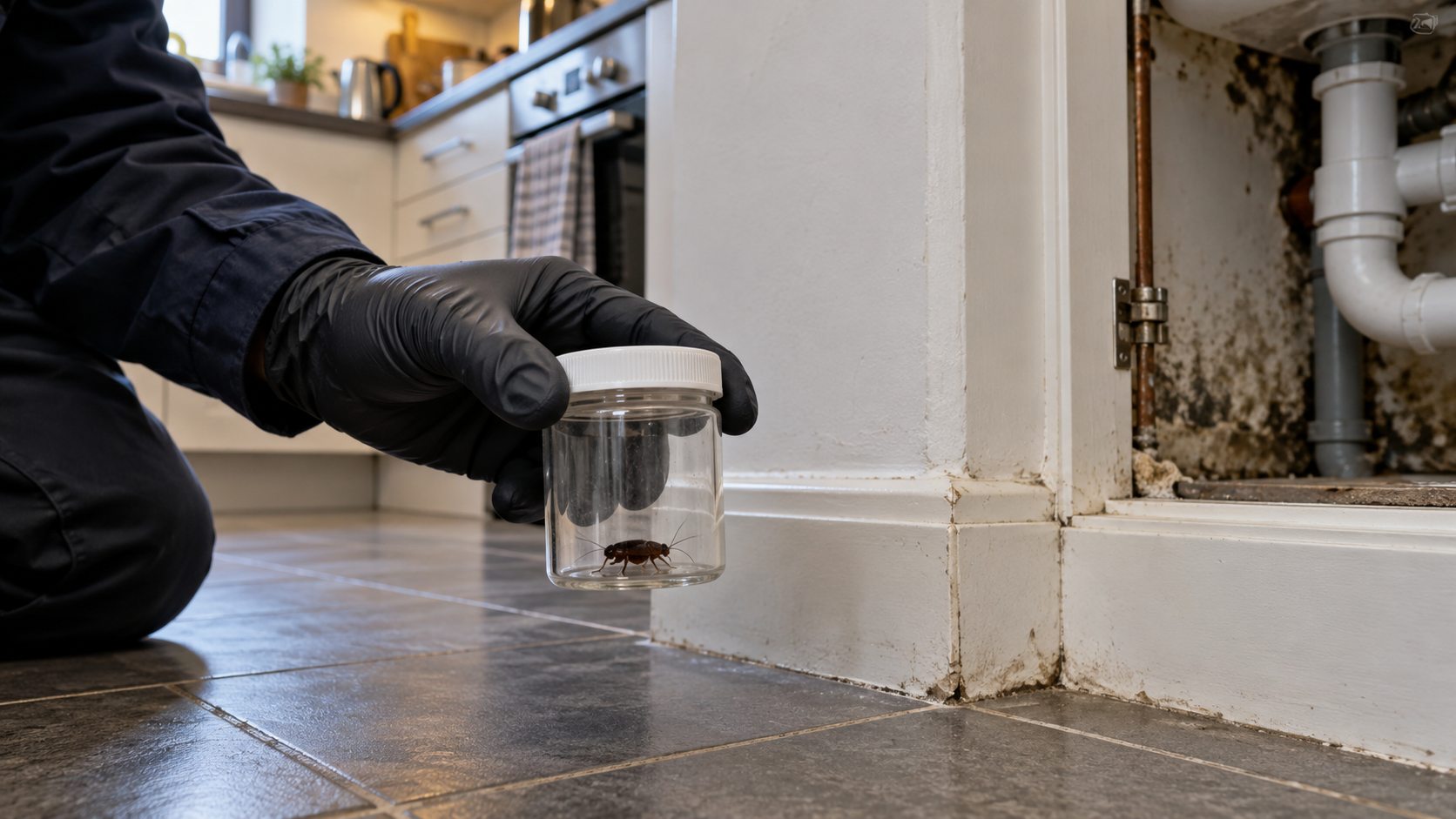
Measure against something familiar rather than guessing from memory. A coin or ruler beside a safely contained specimen gives scale. Try a sharp photograph from above so the shield behind the head is visible; a side view can help with the wings. Do not handle a live cockroach with bare hands or dismantle electrical equipment to chase it. If it can be contained safely, keep the closed pot and record the room, time and exact spot. A specimen flattened under a shoe loses many of the details needed for identification.
A small, dark insect is not automatically a German cockroach, and a dark one is not automatically Oriental. Immature cockroaches lack adult wings and can have different markings. Recently moulted individuals can look unusually pale. Other insects may be mistaken for cockroaches altogether. Where the photograph does not show the relevant features, it is more honest to record “cockroach suspected” than to build a treatment plan around a confident but unsupported species name.
Why a warm kitchen points towards one survey route
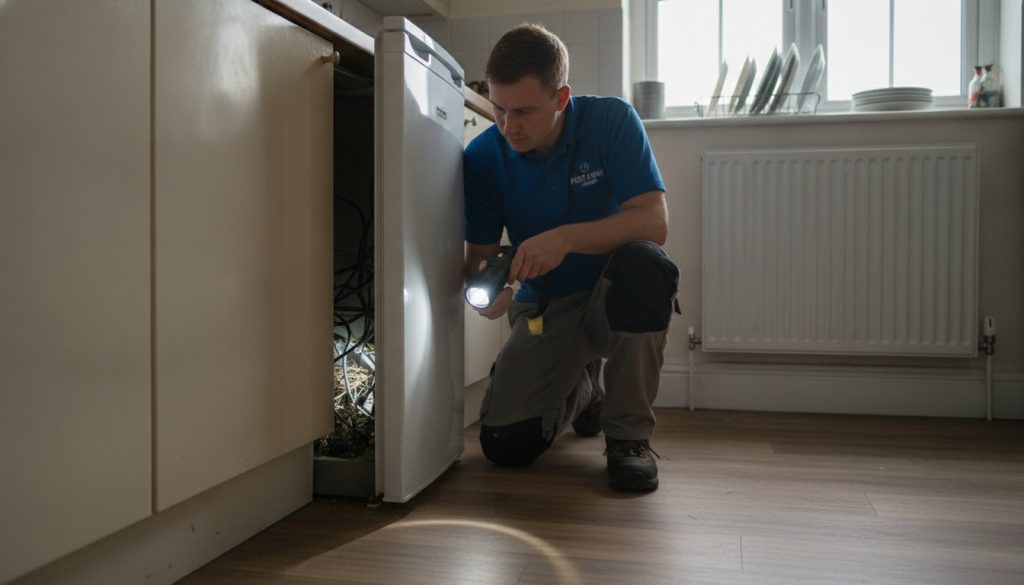
German cockroaches favour warm, humid shelter inside buildings. In a flat, the first close inspection may centre on the rear and underside of a fridge, the motor area of a dishwasher, the gap around an oven, hinges and seams of cupboards, and the plumbing beneath a sink. In a restaurant, warm equipment, service penetrations and preparation areas deserve the same careful attention. The insect you see in the open may have travelled only a short distance from a narrow crevice.
That does not mean every kitchen sighting confirms a colony under an appliance. A cockroach might have arrived with a delivery, moved from an adjoining unit or been disturbed by building work. A technician looks for more than the insect itself: repeated sightings in the same zone, cast skins, droppings, egg cases and catches on correctly placed monitors. A single unexplained adult and several small insects behind the same machine carry very different weight. The latter suggests that breeding close by needs to be investigated.
In blocks of flats, a warm service riser can link otherwise tidy homes. If sightings continue after a room has been cleaned and treated, ask whether the route extends behind units or into shared areas. That is a property question, not a judgement on a resident’s housekeeping. It also explains why the timescale for cockroach treatment depends on monitoring and access rather than on the first day with no visible insects.
Why a damp lower level changes the search
Oriental cockroaches are more closely associated with cool, damp places. A sighting beside a basement door, in a plant room, near a waste area or around ground-floor pipework prompts a search for moisture, sheltered edges and routes from outside or from shared voids. The inspection may extend to a cellar, a service corridor, a leaking pipe chase, damaged seals and sheltered areas immediately beyond an external door. The aim is to find the source and the route, not to assume that the insect was born where it was noticed.
“Near a drain” is a clue, not proof that a drain is broken. The insect may have followed a damp edge, entered through a nearby gap or come from another sheltered space. Equally, a cockroach found upstairs does not rule out Oriental cockroaches: building services can connect floors, and insects move. The location helps prioritise inspection, while the specimen and further evidence settle the identification.
This distinction matters especially in older London conversions with cellars, shared pipe runs and awkward gaps behind fitted joinery. Treating a clean kitchen surface will not correct a wet void or an unsealed service penetration below it. Conversely, spending the first visit searching the garden for a small, striped German cockroach repeatedly found behind a hot appliance would miss the likelier harbourage. A good survey remains willing to change direction when the evidence changes.
A comparison you can actually use
| Feature | German cockroach | Oriental cockroach |
|---|---|---|
| Adult size | Usually around 10–15 mm | Usually around 20–24 mm |
| Adult appearance | Light brown; two dark stripes behind the head | Dark brown to black; often glossy |
| Wings | Adult wings well developed | Male wings short; female wings reduced |
| First places to inspect | Warm appliance gaps, kitchen and bathroom crevices | Cool damp basements, service spaces, ground-level routes |
| Important limit | Juveniles and poor photographs may obscure the stripes | A dark insect beside a drain does not prove its origin |
The measurements and broad habitat differences follow the BPCA cockroach advice. They are guides to the first inspection, not a substitute for seeing an intact insect. An identification guide from the University of Maryland Extension also stresses that different species use different parts of a building. Its US habitat details should be interpreted in the context of a UK property rather than copied as a London distribution map.
Egg cases and nymphs: useful evidence, easy to over-read
People often find a brown capsule in a cupboard and try to name the species from that alone. Cockroach egg cases can be important evidence, but size, damage and the angle of a photograph can make comparison uncertain. German females carry the case until close to hatching; Oriental females deposit theirs in a sheltered place. That difference can help an experienced inspector understand what is happening, but finding an empty case does not establish that live insects are still present today.
Likewise, a small insect is not necessarily a baby German cockroach. An Oriental nymph is also smaller than an Oriental adult, and its lack of adult wings removes one obvious clue. Keep a close-up photograph with scale and note whether several sizes were seen together. Do not scrape away every speck before the visit. The older guide to cockroach egg cases describes what a case can look like; the decision here is whether the surrounding evidence connects that case to the current sighting.
Droppings, shed skins and a persistent odour can support a diagnosis, but none should be assessed in isolation. Damp spots, food crumbs and ordinary household debris have their own explanations. A technician weighs where the signs occur, how fresh they appear, and whether monitoring catches insects from the same area. That is more reliable than declaring an infestation from one ambiguous mark.
What to do before anyone treats the room
Write down the date, time and exact location of each sighting: “behind fridge, right-hand rear corner” is far more useful than “kitchen”. Photograph the insect beside a scale if this can be done without putting anyone at risk. Note whether it was seen in daylight, whether others have appeared, and whether the area is warm, wet or linked to shared services. In a managed building, record the floor and whether a communal corridor, bin room or plant area is involved. These details help decide where access is needed.
Keep food sealed, remove accessible crumbs and waste, and report leaks. Avoid pulling out wired appliances or taking apart fitted units. Resist the temptation to spray every visible crack before identification. A blanket spray can disturb insects and obscure the pattern an inspector needs to follow; it may also conflict with a later targeted treatment. If a product has already been used, tell the technician what it was and where it went.
For a food business, record the sighting in its normal pest log and follow its food-safety procedure for affected stock and surfaces. Do not wait for a species name before managing any immediate contamination concern. The wider restaurant pest-control guide covers documentation and prevention; species identification then sharpens the location and scope of the inspection.
What a species-led visit should answer
An effective visit should leave you with a working identification, the evidence behind it and a map of the likely harbourage. The technician may use discreet monitors to test whether activity is concentrated behind warm equipment, along a damp lower-level route or in both places. They should explain which areas were accessible, which were not, and what further access or repair might be needed. In a shared building, the answer may include speaking to the managing agent about communal risers or neighbouring units.
Treatment can then be placed where insects actually shelter and travel, with follow-up to check whether activity falls. The product or method is not chosen from the species name alone: occupancy, food handling, children, pets, surfaces and practical access also matter. A damp source should be repaired where possible; a kitchen harbourage should remain accessible for inspection and review. Neither species justifies a promise that one visit will always finish the job.
If you have a clear photograph or a contained specimen, send it with the room and building details when you contact Panther Pest Control. If you do not, describe the features you saw and say where the uncertainty lies. A cautious first identification is far more useful than a confident guess that sends the inspection to the wrong part of the property.

Al Joel is a practical writer and long-term property maintenance specialist focused on real-world pest control, home safety and prevention advice. His guides translate common warning signs into clear next steps for homeowners, tenants, landlords and property managers.His approach begins with correct identification. A sighting in one room may originate from a neighbouring flat, service riser, drainage, roof space, delivery or communal waste area. Al explains how to preserve useful evidence, reduce food and water sources, avoid spreading activity and choose proportionate treatment.What readers can expectClear identification clues and practical inspection stepsSafe preparation, cleaning and aftercare guidancePrevention advice for homes, flats and commercial premisesHonest guidance on when DIY is reasonable and when professional help is the smarter optionWhen professional help makes senseRepeated sightings, activity in several rooms, uncertain identification, vulnerable occupants or signs involving food, electrics and shared building routes deserve a professional inspection. A lasting solution normally combines targeted treatment with proofing, hygiene and follow-up monitoring.Explore the Pest Library, learn how treatment works, or request property-specific advice.