Pest Control · LONDON
Ants in House: A Professional Guide to London Home Eradication
Most homeowners treat the ants they see, but the real problem is the colony architecture you don't see. Dealing with ants in house requires more than...
Most homeowners treat the ants they see, but the real problem is the colony architecture you don’t see. Dealing with ants in house requires more than a supermarket spray that only kills the scouts and leaves the queen to produce more. It’s an exhausting cycle that leaves you worrying about the hygiene of your kitchen surfaces every time you make a cup of tea.
We understand that finding ants in sealed food containers is a distressing breach of your home’s security. You want a solution that actually works without turning your living space into a chemical hazard for your pets or children. We recently dealt with a basement flat in Islington where ants were bypassing every DIY trap by travelling through the Victorian brickwork. It’s a common issue; amateur treatments often fail because they don’t account for the complex layout of London’s diverse housing stock.
This guide provides the professional framework needed to identify entry points and execute a permanent removal strategy. You’ll learn how to contain the spread and apply technician-led methods that target the source of the infestation rather than just the visible symptoms. By the end, you’ll have a clear path to a pest-free kitchen and the peace of mind that comes with a professionally secured home.
Key Takeaways
- Distinguish between the common Black Garden Ant and the more resilient Pharaoh Ant to ensure your eradication strategy matches the specific species behaviour.
- Understand how London’s Victorian brickwork and shared terraced walls allow ants in house to bypass surface barriers and move between properties.
- Learn why supermarket sprays and home remedies often fail by only killing visible scouts whilst leaving the queen safely hidden deep within the structure.
- Discover the correct way to disrupt pheromone trails and sanitise affected areas to stop an active invasion from spreading further into your kitchen.
- Explore how professional-grade gel baits leverage the colony’s own foraging patterns to deliver a decisive treatment directly to the primary nest site.
Identifying Ants in the House: Beyond the Occasional Scout
Finding a lone ant on your worktop isn’t just a minor nuisance. It’s an intelligence mission. These individuals are scouts, tasked with locating food sources and marking a chemical path for the rest of the colony to follow. If you spot one or two, it’s a signal that a much larger population is already established nearby, likely within your walls or under your floorboards. The presence of ants in house settings often indicates a breach in your property’s external seal that needs immediate attention.
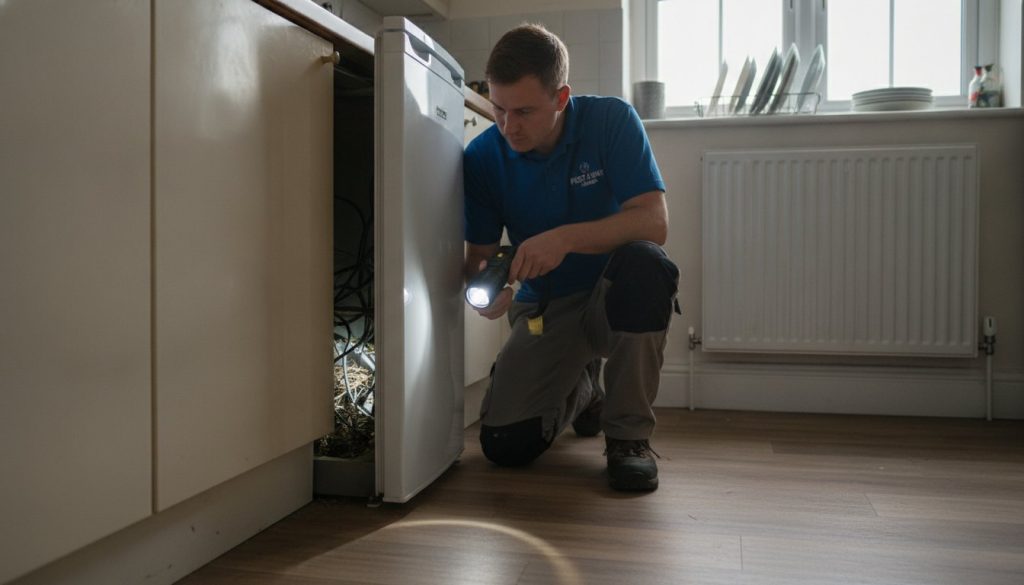
We often see ants in house infestations across Fulham where older Victorian conversions have shared service voids. These hidden gaps between floors allow insects to travel between flats undetected, making the source of the problem difficult to pin down without a professional pest inspection. Common hotspots include the warm, damp areas behind dishwashers, beneath bathroom skirting boards, or inside kitchen cupboards where crumbs go unnoticed. These areas provide the perfect microclimate for a colony to thrive undisturbed.
To better understand how these scouts operate and identify the scale of the problem, watch this helpful video:
Black Garden Ants vs. Pharaoh Ants
The most frequent intruder is the Black Garden Ant (Lasius niger), which is dark, opaque, and roughly 3-5mm long. However, London’s heated apartment blocks frequently house the more problematic Pharaoh Ant. These are smaller, yellowish-brown, and almost translucent. Whilst garden ants usually nest outdoors, Pharaoh ants prefer the internal warmth of central heating systems. They are notoriously difficult to treat because they respond to stress through “budding”, where the colony splits into multiple new queens if they feel threatened by amateur sprays.
Signs You Have a Deep-Rooted Infestation
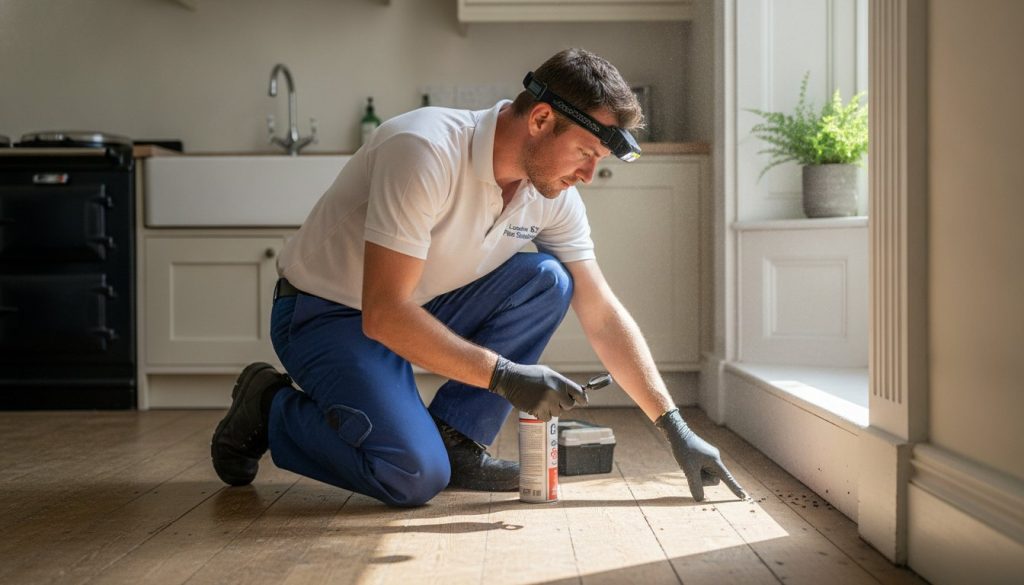
A persistent trail of ants is the most obvious sign, but you should also look for “frass”. This is a fine, sawdust-like debris that ants push out of their nesting holes as they expand their territory. You might also notice increased activity whilst the house is quiet at night. Many species are more active in the dark when there is less foot traffic to disturb their foraging lines. If you can trace a line of foragers disappearing into a crack in the masonry or behind a kitchen cabinet, you’ve found a structural entry point that requires sealing. Identifying these trails early is the only way to prevent a minor scouting mission from becoming a permanent occupation.
The London Factor: Why Ants Love Terraced Houses and Flats
London’s unique architectural heritage is a primary driver for persistent infestations. Unlike modern detached builds, our terraced houses share more than just a postcode. In areas like Croydon or Camden, a single colony can span across multiple properties through shared wall cavities. When you find ants in house settings here, you’re often seeing the overflow from a neighbour’s untreated void.
Victorian foundations are particularly problematic. Settling floorboards and porous brickwork create subterranean highways that lead directly into your living spaces. We frequently find that modern rear extensions actually exacerbate the problem. The expansion gap between the new build and the original stock brickwork provides a sheltered, temperature-controlled entry point that is almost impossible to seal without specialist equipment.
Pharaoh ants present a different challenge in London’s high-rise blocks. They utilise communal heating pipes to travel between floors, meaning an infestation on the ground floor can reach the tenth floor in days. This species thrives on the consistent warmth of urban infrastructure. For those managing complex property layouts, professional ant control methods are essential to map these internal routes and stop the spread.
Structural Vulnerabilities in Period Properties
Suspended timber floors are a major vulnerability in older London homes. These floors sit above large, dark voids that remain undisturbed for decades, allowing colonies to grow to massive sizes. In Greenwich, we often treat lower-ground flats where damp-damaged mortar has crumbled over time. Ants exploit these softened joints to bypass your skirting boards entirely, entering through the very fabric of the building.
The Role of Local Urban Environments
Urban density plays a significant role in pest behaviour. Residential properties near Soho’s commercial hubs often deal with ants attracted to the grease build-up found in high-volume commercial kitchens. Similarly, houses with heavy ivy growth on the exterior provide a natural ladder for insects to reach upper-floor windows. Communal bin stores in large residential complexes act as a constant food source, sustaining colonies that eventually migrate indoors when the weather shifts. If your property’s layout is making eradication difficult, you can speak with our technical team for a site-specific assessment.
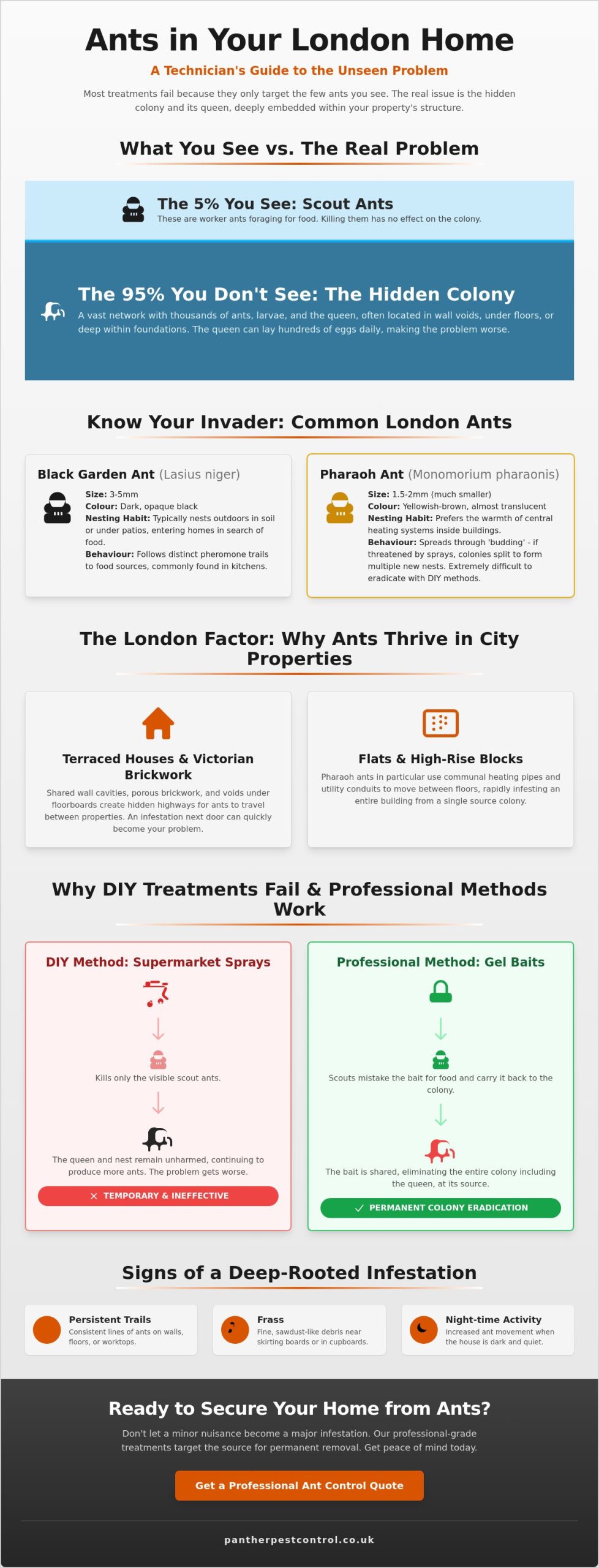
Why DIY Ant Treatments Often Backfire
The primary reason most DIY attempts fail is the “Barrier Myth”. Homeowners often reach for peppermint oil or white vinegar to block entry points. These are deterrents, not exterminants. They temporarily redirect the trail but do nothing to neutralise the queen. Whilst the visible trail might disappear for a day, the colony remains active behind the scenes, searching for a new route into your pantry. You haven’t solved the problem; you’ve just moved it.
Supermarket sprays are largely contact-killers. They kill the ants you see instantly. However, they fail to reach the source hidden deep within the wall. For certain species like Pharaoh ants, this is a dangerous approach. Using the wrong chemicals triggers a survival mechanism called “budding”. The colony detects the threat and splits into multiple new queens, effectively multiplying your ants in house problem overnight. It’s a biological response that amateur products simply aren’t designed to handle.
We recently assisted a family in Clapham who had been using retail aerosols for months. By the time they called us, the ants had been driven away from the kitchen and had established a new nest inside their electrical sockets. This is the reality of incomplete eradication. You might clear the worktop, but the colony architecture remains intact. Effective managing an active ant invasion requires an understanding of colony biology rather than just surface-level cleaning.
Deterrents vs. Exterminants
Coffee grounds and cinnamon are nuisance barriers. They might irritate an ant, but they won’t stop a hungry colony. Bait stations are a better tool, but they are frequently misused. Placing a bait in the middle of a high-traffic area can actually attract more ants into your home than were there originally. Professional placement targets the foraging path without inviting new scouts inside. Precise execution is what distinguishes a successful treatment from a temporary reprieve.
The Cost of Delaying Professional Help
Delaying treatment leads to significant food contamination. We’ve seen entire larders of dry goods ruined because scouts found a microscopic gap in the packaging. Beyond the financial loss, the psychological impact of “ant anxiety” shouldn’t be underestimated. Living in a space where you can’t trust the hygiene of your surfaces causes genuine distress. Professional intervention restores that sense of security by ensuring the nest is gone for good, rather than just hidden.
Step-by-Step: How to Manage an Active Ant Invasion
Finding ants in house kitchens usually triggers a panic-cleaning response. This is helpful, but it must be systematic to be effective. Whilst you wait for a technician, your role shifts from exterminator to observer. Start by removing the high-value attractant, which is often a sugar spill or a protein source behind a heavy appliance. Removing the target food source immediately halts the recruitment of new foragers from the nest.
Instead of killing every ant you see, map their route. Tracing the line back to a skirting board or a window frame provides us with vital data during our inspection. Amateur efforts often involve wiping trails with plain water, but this merely spreads the chemical markers. A professional standard of containment requires neutralising pheromone paths to prevent the colony from simply following the same scent bridge back to your worktops. If the situation is escalating despite your efforts, you can request a professional ant treatment to secure your property.
Eliminating Pheromone Trails
Ants follow the leader using an invisible chemical scent. You must break this link. Use a solution of soapy water or a 50/50 vinegar-water mix to scrub the “scent bridge” on floor joins and skirting boards. This doesn’t kill the colony, but it disrupts their navigation. We often see homeowners forget to clean the vertical surfaces of cabinets, which allows ants to continue their mission undetected beneath the counter lip.
Pantry Protection Protocols
Move all dry goods into airtight glass or plastic containers immediately. Cardboard boxes and thin plastic bags offer no resistance to a determined scout. Pay close attention to “hidden grease” on the sides of honey pots or jam jars. These sticky residues act as a beacon for the entire colony. If you choose to use a temporary bait, it must be placed exactly on the active trail; moving it even a few inches can render it useless.
External Proofing Basics
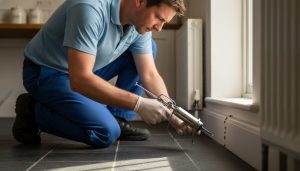
Inspect your external brickwork for the “Ant Highway”. We recently worked on a ground-floor conversion in Islington where ants were using a trailing ivy vine to enter through a first-floor bathroom window. Ensure no branches or heavy foliage touch your walls. For obvious entry points around window frames, a temporary application of silicone sealant can slow the invasion. However, sealing cracks whilst the colony is still inside often forces them to find new, more intrusive routes through your electrical internal voids.
Professional Eradication: The Panther Approach to Permanent Ant Control
Professional intervention is the only way to break the cycle of re-entry. When dealing with ants in house infestations, we don’t just treat the visible trail. We target the colony architecture. Our approach relies on technical expertise to identify the exact species and locate the primary nest site, which is often hidden deep within structural voids or sub-floors.
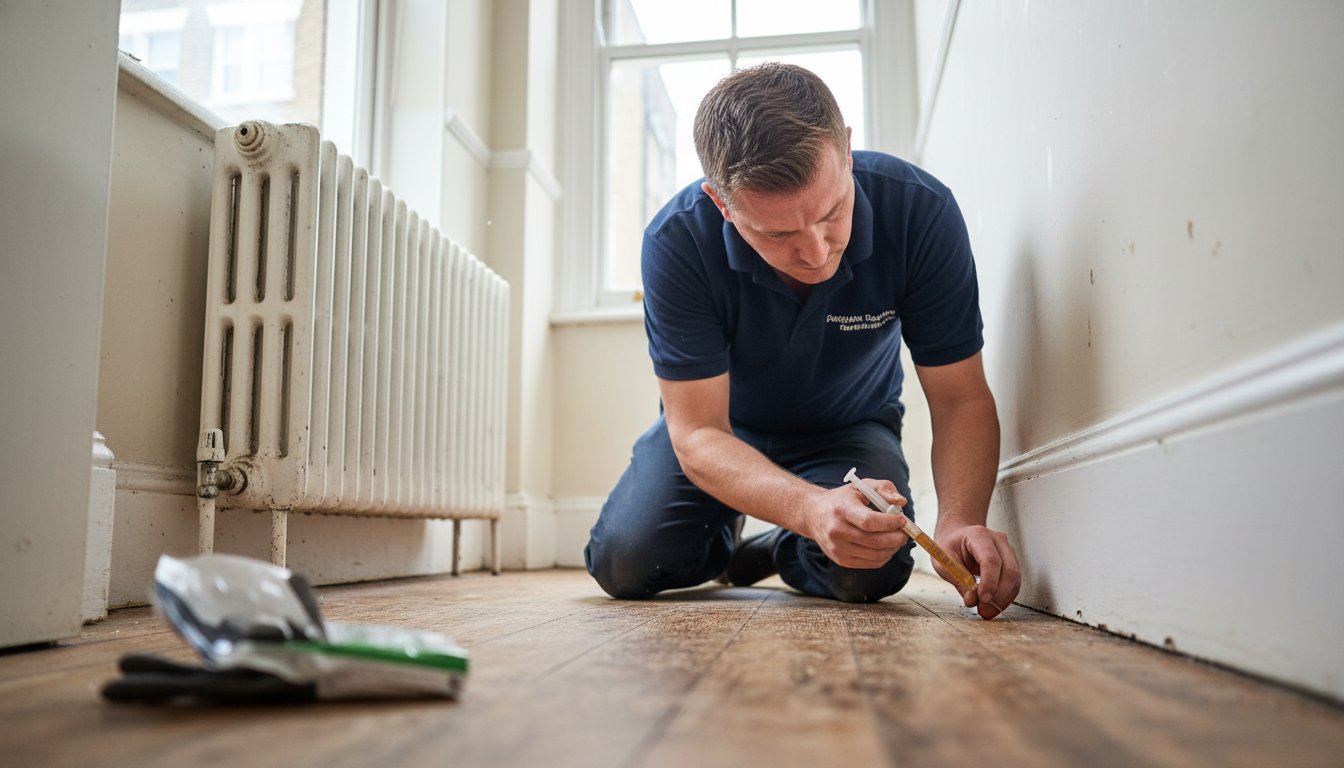
Amateur sprays fail because they don’t reach the queen. We use advanced baiting technology, employing professional-grade gel baits that foragers carry back to the heart of the nest. This ensures the entire colony is neutralised from the inside out. We follow this with targeted residuals applied to entry points, creating a professional standard of protection that prevents future scouts from establishing new trails.
We recently handled a complex case in a converted townhouse where ants were nesting behind a kitchen’s integrated appliances. Surface cleaning couldn’t reach the source. By using species-specific baits, we cleared the infestation without the need for invasive structural work. Our rapid London response ensures that these biological threats are handled before they can spread to neighbouring properties or contaminate your entire pantry.
Our Professional Treatment Process
Every job begins with a technician-led pest inspection. We check voids, loft spaces, and plumbing entries to map the colony’s footprint. This data allows us to select the right protein or sugar-based bait for the specific species. We don’t sign off a job until we’ve confirmed the colony is completely dead, providing a level of accountability that retail products cannot match.
Why Londoners Choose Panther
Our technicians understand the unique layout of London terraces and flats. We know how ants move through shared walls and Victorian foundations. We offer transparent pricing with no hidden fees, ensuring you know exactly what the eradication will cost before we start. To maintain your privacy in dense residential areas, we use discreet, unmarked vehicles for all call-outs. You can get a professional ant treatment quote today and restore the hygiene of your home.
Restoring Your Home’s Hygiene and Security
A persistent infestation is rarely a failure of cleanliness. It’s usually a failure of structural exclusion. We’ve seen how ants in house settings often originate from deep within London’s Victorian brickwork or shared service voids. Relying on temporary deterrents only delays the inevitable return of the scouts whilst the primary colony continues to grow. Permanent eradication requires a technician who understands species biology and the specific architectural layout of local properties.
Our expert technicians provide a 24/7 emergency response across all London boroughs. We utilise eco-friendly and pet-safe treatment options to ensure your living space remains secure for your family and pets. By targeting the nest architecture rather than just the visible trails, we provide a definitive resolution to your pest concerns. You don’t have to tolerate the stress of contaminated food or compromised surfaces.
Take the final step towards a pest-free kitchen today. Secure your home from ants with Panther Pest Control and regain the peace of mind you deserve. Our team is ready to provide the expert intervention needed to protect your domestic environment.
Frequently Asked Questions
Are ants in the house dangerous to my health?
Most UK species aren’t directly venomous or disease carriers, but they represent a significant hygiene risk. Ants often forage in bin stores or drains before walking across your kitchen worktops and food preparation areas. This mechanical transmission of bacteria can contaminate your surfaces. Finding ants in house settings is a clear sign that your internal sanitation is being compromised by external contaminants.
How much does professional ant control cost in London?
The total cost depends on several factors including the species identified, the size of your property, and the severity of the nesting site. A standard treatment for Black Garden Ants in a terraced house is generally less complex than managing a multi-storey Pharaoh Ant infestation in a block of flats. We recommend checking current market rates or requesting a site-specific survey for an accurate assessment of your property’s requirements.
Can I get rid of ants permanently using just vinegar or lemon?
Natural solutions like vinegar or lemon are only effective as temporary deterrents. They disrupt the pheromone trails that scouts use to navigate, but they don’t kill the queen or destroy the nest. Whilst you might see a temporary reduction in activity, the colony will simply find a new route into your kitchen. Permanent eradication requires professional-grade baits that target the colony’s reproductive centre.
Why do I have flying ants in my house during the summer?
Flying ants are reproductive males and queens leaving an established nest to start new colonies. This usually happens on warm, humid days in July or August, a phenomenon often called “nuptial flight”. If you see them inside, it’s likely a nest is located within your property’s structure rather than just in the garden. These swarms are brief but indicate a mature colony is present nearby.
How long does it take for professional ant treatment to work?
Full eradication typically takes between 7 and 14 days. Our gel baits are designed to be slow-acting so that foragers have enough time to carry the treatment back to the queen and the rest of the colony. You may see a brief increase in activity immediately after baiting as ants are drawn to the new food source. This is a normal part of the process and shows the treatment is working.
Are your ant treatments safe for my pets and children?
Yes, we utilise professional-grade products specifically approved for use in domestic environments. Our technicians focus on “crack and crevice” treatments, placing gel baits in hidden voids, behind appliances, and inside wall cavities where pets and children cannot reach them. We prioritise safety by targeting the specific biology of the ants in house rather than using broad-spectrum sprays that linger on open surfaces.
Will ants go away on their own in the winter?
Outdoor colonies of Black Garden Ants usually go dormant during the winter, but ants nesting inside heated London properties stay active year-round. Pharaoh Ants, in particular, rely on the constant warmth of central heating and communal pipework to survive the colder months. Don’t assume the problem is solved just because it’s cold outside; internal infestations require active intervention regardless of the season.
What is the most common entry point for ants in a London flat?
The most frequent entry points are the service voids around plumbing and electrical conduits. In many London buildings, these gaps aren’t properly sealed, allowing insects to travel between floors and neighbouring flats with ease. We often find that ants enter through the gaps behind kitchen sinks or where radiator pipes meet the floorboards. Identifying these structural vulnerabilities is the first step in our professional exclusion process.

Al Joel is a practical writer and long-term property maintenance specialist focused on real-world pest control, home safety and prevention advice. His guides translate common warning signs into clear next steps for homeowners, tenants, landlords and property managers.
His approach begins with correct identification. A sighting in one room may originate from a neighbouring flat, service riser, drainage, roof space, delivery or communal waste area. Al explains how to preserve useful evidence, reduce food and water sources, avoid spreading activity and choose proportionate treatment.
What readers can expect
- Clear identification clues and practical inspection steps
- Safe preparation, cleaning and aftercare guidance
- Prevention advice for homes, flats and commercial premises
- Honest guidance on when DIY is reasonable and when professional help is the smarter option
When professional help makes sense
Repeated sightings, activity in several rooms, uncertain identification, vulnerable occupants or signs involving food, electrics and shared building routes deserve a professional inspection. A lasting solution normally combines targeted treatment with proofing, hygiene and follow-up monitoring.
Explore the Pest Library, learn how treatment works, or request property-specific advice.