Pest Control · LONDON
Professional Ant Infestation Kitchen London Removal & Prevention Guide
Emptying a bottle of supermarket spray onto a visible trail of ants might feel satisfying, but it's often the quickest way to ensure they return next...

Emptying a bottle of supermarket spray onto a visible trail of ants might feel satisfying, but it’s often the quickest way to ensure they return next week. Most homeowners in the capital don’t realise that surface treatments only kill the foragers, not the hidden nest. When dealing with an ant infestation in kitchen London properties, these amateur fixes can actually trigger a colony to split, which spreads the problem into other rooms. It’s about long-term prevention, not quick fixes.
It’s exhausting to maintain a spotless home only to find ants inside your sealed cupboards every morning. You deserve a kitchen that’s actually hygienic, not just one that looks clean on the surface. This guide will show you how to identify the specific species invading your space and how to eradicate the entire colony structure using professional technician insights. We’ll walk through the process of finding hidden entry points in London’s unique Victorian conversions and modern flats, ensuring you move from temporary relief to a properly defended home.
Key Takeaways
- Understand how London’s high-density housing and shared wall cavities create hidden motorways for ants to travel between properties.
- Learn to distinguish between common Garden ants and tropical Pharaoh ants to avoid treatments that accidentally cause a colony to split.
- Discover the professional baiting philosophy that uses social behaviour to deliver non-repellent gels directly to the queen.
- Identify why an ant infestation in kitchen London properties requires specialist pest-proof fillers rather than standard DIY silicone sealants.
Understanding Why London Kitchens Attract Persistent Ant Infestations
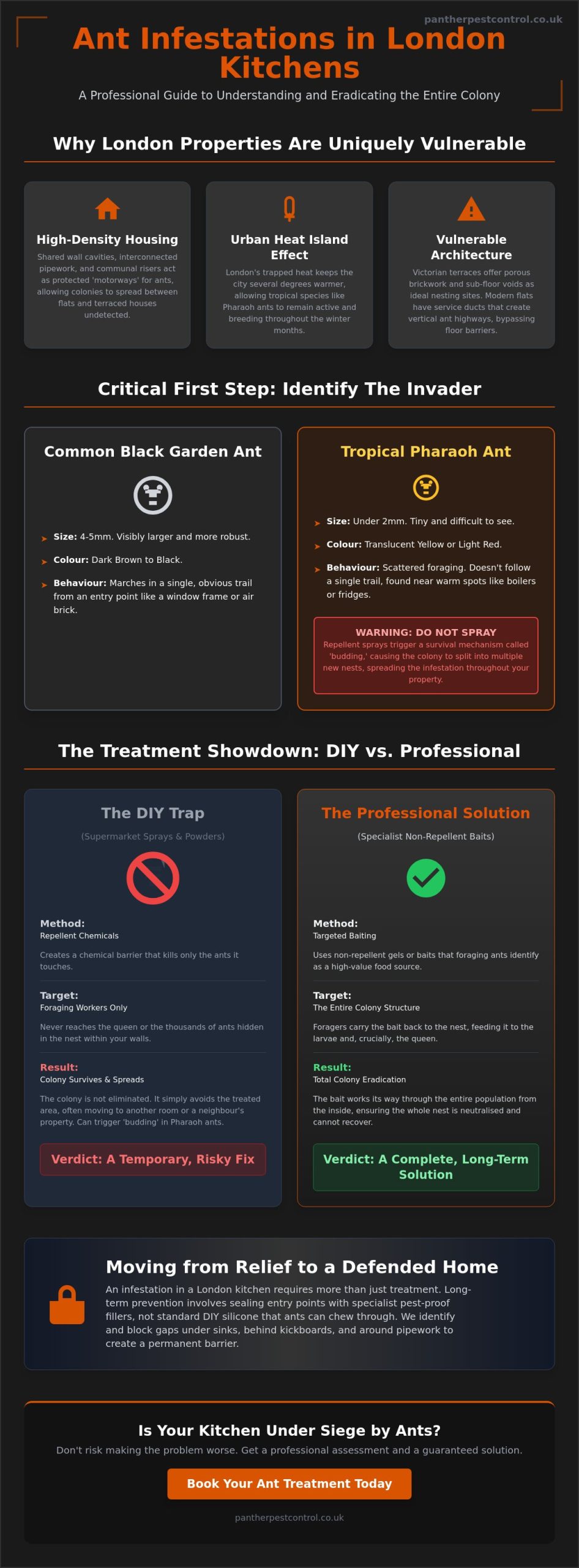
A true ant infestation in kitchen London properties isn’t defined by the ten foragers you see on the counter; it’s the thousands living within your walls. These pests colonise the structural voids of the building, meaning the kitchen is merely their canteen. London’s high-density housing provides a unique advantage for them. Shared wall cavities and interconnected pipework act as protected highways, allowing a colony to expand across multiple flats or terraced houses simultaneously.
The “urban heat island” effect also plays a massive role in the capital. London’s concrete and brick trap heat, keeping the city several degrees warmer than the surrounding countryside. This allows tropical species like Pharaoh Ants to remain active and breeding throughout the winter, whereas they’d typically die off in colder climates. To better understand this concept, watch this helpful video:
The Role of London Property Architecture
Victorian terraces are particularly vulnerable. Their porous brickwork and extensive sub-floor voids provide endless nesting sites that are almost impossible to reach with DIY sprays. In modern apartment blocks, the problem shifts to communal risers and service ducts. These vertical shafts carry heat and moisture, serving as perfect ant motorways that bypass traditional floor-level barriers. Common entry points often include plumbing penetrations under the sink or gaps behind kitchen kickboards that were never properly sealed during installation.
Environmental Factors: Beyond Simple Crumbs
Cleanliness is helpful, but it’s rarely the cure. Even a spotless kitchen can harbour a colony if there’s an alternative food source nearby. In areas like Camden, heavy grease build-up in shared extraction fans provides a high-protein food source that ants can rely on. Water is equally critical. A slightly leaky tap or internal condensation behind a fridge can provide enough moisture to sustain a massive population. If the colony is already established in the building fabric, simply wiping the sides won’t stop them.
One of our technicians recently attended a property in Fulham where the owner was baffled by a recurring trail. We discovered a nest thriving directly behind the heat-damaged sealant of a high-end range cooker, where the warmth created a perfect breeding microclimate.
Identifying the Species: Garden Ants vs. Tropical Pharaoh Ants
Misidentifying an ant infestation in kitchen London properties is a common mistake that leads to months of frustration. You can’t treat all ants the same way. The method used for a simple garden trail will fail miserably against tropical species. Proper identification is the foundation of any successful treatment. Without it, you’re just guessing.
Visual and Behavioural Differences
The Black garden ant is the species most Londoners recognise. They’re dark, relatively large at 4-5mm, and usually march in a single, obvious line from a gap in the masonry or a window frame. In contrast, Pharaoh ants are tiny, translucent yellow or red, and rarely exceed 2mm. They don’t just follow one trail. You’ll find them scattered around warm spots like boiler cupboards or behind the fridge. Ghost ants are also becoming a frequent sight in the capital. They’re even harder to spot due to their pale, almost invisible bodies and erratic, fast-paced movement.
If you suspect Pharaoh ants, put the spray down immediately. These tropical pests use a survival mechanism called “budding.” When they sense a repellent chemical or a threat to the nest, the colony panics and the queens split into multiple new groups. You might start with one problem near the sink and end up with three separate colonies in the bathroom and airing cupboard within days.
Why DIY Ant Powders Often Fail in London
Most shop-bought powders and sprays are repellents. They kill the foragers on the surface but leave the queen protected deep within the wall voids. In a high-density London terrace, this just pushes the foragers into your neighbour’s kitchen until the chemical wears off. It’s a temporary fix, not a solution. Professional success relies on non-repellent baits that the ants carry back to the nest themselves, ensuring the entire colony is neutralised, not just moved.
Getting the species right the first time saves both money and stress. If you aren’t sure what’s crawling on your worktops, a professional pest inspection is the only way to be certain. You can always speak to our team to discuss the specific behaviour you’re seeing in your home and get expert advice on the next steps.
The Professional Eradication Process: Clearing Your Kitchen Properly
Professional extermination relies on social engineering, not just chemicals. We use the ants’ own biology against them through a process called baiting. This involves using non-repellent gels that foragers find more attractive than the sugar or grease in your cupboards. The goal is to ensure they transport the bait back to the nest to feed the queen. It is a solution based on colony collapse, not just surface cleaning.
Expect a brief surge in activity. You might see more ants for the first 24 hours as they flock to the new food source. This is a positive sign. As highlighted in this University of Kentucky guide to ant control, the foragers must remain alive long enough to distribute the bait throughout the entire nest hierarchy. If you spray them now, you break the chain and the treatment fails.
Step 1: Forensic Inspection and Mapping
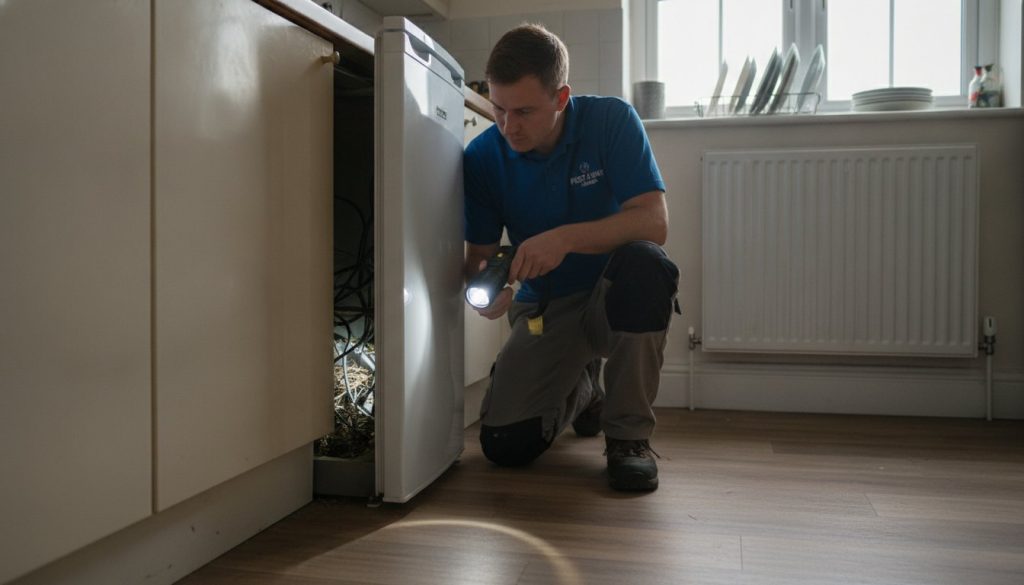
We don’t start by applying products; we start by looking. Our technicians track trails back to their structural source using non-invasive methods. We focus on “hotspots” that provide the warmth ants crave, such as dishwasher motors, fridge compressors, and the voids behind under-sink cupboards. We also check adjacent rooms to ensure an ant infestation in kitchen London flats hasn’t already migrated into the wall cavities of the living room or bathroom.
Step 2: Strategic Bait Placement
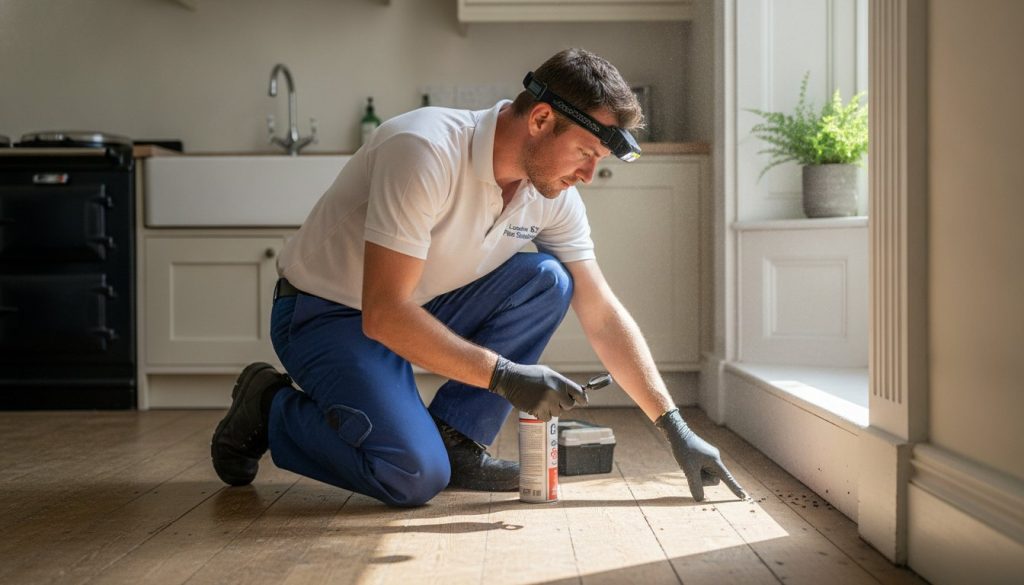
Gels are placed precisely in areas where ants travel but children and pets cannot reach. This targeted method avoids “space spraying,” which is often ineffective and risks contaminating food preparation surfaces. We prioritise high-traffic junctions behind kickboards and around plumbing penetrations. For the treatment to work properly, you must remove competing food sources. A single forgotten honey jar can distract the foragers from the bait.
A recent job in a Soho restaurant kitchen perfectly illustrates this. The staff were frustrated by ants appearing on a central prep island. We mapped the activity to a hollow stainless steel table leg where a colony had nested. By applying targeted baiting directly to the leg’s entry point, we eliminated the nest without interrupting the restaurant’s busy service.
Step 3: Monitoring and Final Clearance
The job isn’t finished until the activity stops completely. We monitor the site to verify the queen is dead, which is evidenced by a total cessation of trailing. For complex species like Pharaoh ants, a follow-up visit is mandatory to ensure no “budding” has occurred in neighbouring wall voids. You can view our professional pricing for a clear breakdown of treatment costs. If you need an expert to assess your property, get a professional quote today to resolve the issue properly.
Long-term Proofing Strategies for London Property Types
Eliminating the nest is only half the battle. To prevent a recurring ant infestation in kitchen London homes, you must transition from extermination to structural defence. Ants are opportunistic. If your property remains porous, a new colony will simply move into the vacant territory left by the last one. Proper proofing is about denying entry, not just reacting to trails.
Many homeowners rely on standard silicone sealant. This is a mistake. Ants can often chew through soft silicone or find tiny gaps where the bond has pulled away from London’s shifting Victorian masonry. We use specialist pest-proof fillers and metal-loaded compounds that provide a permanent barrier. It’s about doing the job properly, not temporarily.
Structural Proofing for Victorian and Georgian Homes
London’s historic housing stock is notoriously difficult to seal. Gaps around original sash windows and the voids where old floorboards meet the skirting boards are primary entry points. In a recent job in Islington, we found ants were entering through crumbling mortar in the sub-floor air bricks. By installing fine stainless steel mesh over these vents, we maintained essential timber ventilation whilst blocking insect access. It’s worth noting that cockroach control in these older buildings often requires almost identical proofing measures to be effective.
Kitchen Maintenance and “Ant-Safe” Habits
Environmental management is your second line of defence. In high-density areas like Camden, grease build-up in communal extraction systems acts as a beacon for scouts. Professional deep cleaning of these systems is vital; if a scout finds a protein source, the rest of the colony follows. Engaging a specialist cleaning service like maintainclean.co.uk ensures that even the most hidden grease and food residues are removed, making your kitchen far less attractive to scouts. Within the home, you should adopt the “Dry Kitchen” rule. Ants crave moisture as much as food. Wiping down your sink and draining board at night removes the water source they need to survive the evening.
Your storage habits also need an upgrade. Tropical species can easily penetrate original cardboard packaging. Move dried goods into airtight glass or plastic containers immediately. Finally, manage pet food bowls strictly. Leaving a bowl of kibble out overnight is essentially providing a refuelling station for an entire trail. Lift the bowl once your pet has finished or use an “ant-proof” water-moated stand to break the scent path.
Follow this essential maintenance checklist to keep your kitchen clear:
- Seal plumbing penetrations under the sink with expanding foam or specialist filler.
- Replace cardboard food boxes with airtight containers.
- Keep kickboards removable to allow for regular inspections and cleaning.
- Ensure all window seals are intact, especially in ground-floor London flats.
- Clean behind heavy appliances where grease and moisture tend to accumulate.
Restoring a Hygienic Kitchen Environment
Solving an ant infestation in kitchen London properties requires a shift from surface cleaning to structural intervention. You now understand why identification is the first critical step and why professional baiting is the only way to reach the queen hidden in Victorian wall voids. It’s about moving beyond the cycle of spraying and seeing them return every summer.
We’ve protected over 20,000 London properties using proven methods tailored to the capital’s unique architecture. Our RSPH-certified local technicians provide a 24/7 emergency response across the M25, ensuring expert help is available when the situation feels out of control. We don’t just treat the visible trail; we secure the building fabric properly.
While our focus is on the unique challenges of the UK capital, these professional standards are universal. In other regions, companies like Source Pest Control offer similar expert management for both residential and commercial properties, ensuring pests are handled using the latest technical methods.
You don’t have to tolerate ants in your food cupboards. Speak directly to a London technician for a same-day ant inspection to resolve the issue for good. Your kitchen should be a safe, hygienic space, and with professional intervention, it will stay that way.
Frequently Asked Questions
How much does professional ant removal cost in London?
A single course of professional ant treatment in London typically costs approximately £165, with most jobs falling between £100 and £230. For complex cases requiring specialised gel treatments, prices generally start from £178 plus VAT. If the situation is severe and requires multiple appointments, subsequent follow-up visits are usually priced around £60 each.
Why do I have ants in my kitchen even though it is clean?
Ants enter clean kitchens primarily for moisture and structural shelter, not just for food scraps. A tiny leak behind a dishwasher or condensation on a cold water pipe provides the hydration a colony needs to thrive. In London’s interconnected terraces, they often migrate through shared floor joists from a neighbouring property where food is more plentiful.
Are kitchen ants in the UK dangerous to my health?
While common garden ants don’t sting, they are a significant hygiene threat because they track bacteria across your worktops. They often forage in drains or waste bins before walking over your food preparation areas. Tropical species, which are a frequent cause of an ant infestation in kitchen London flats, are known to carry pathogens like Salmonella, making them a genuine risk to food safety.
How long does it take for professional ant treatment to work?
You will usually see a sharp decline in activity within 48 to 72 hours, but total colony collapse takes between 7 and 14 days. This timeline is necessary because the workers must have enough time to transport the bait back to the queen. Proper extermination requires patience; killing them too quickly with sprays prevents the bait from reaching the heart of the nest.
Can I stay in the house during an ant treatment?
Yes, you can remain in your home whilst the technician works. We prioritise targeted gel baits rather than traditional space sprays, which means there are no airborne chemicals to worry about. These gels are applied into cracks, crevices, and behind appliances where they are out of reach for children and pets but easily accessible to the ants.
Why did the ants return after I used a supermarket ant spray?
Retail sprays are almost always repellents that only kill the foragers visible on your tiles. This leaves the queen and the rest of the nest unharmed within the wall cavity. By using these products, you often trigger a survival response that causes the colony to relocate to a different part of the kitchen, resulting in the problem returning within weeks.

Al Joel is a practical writer and long-term property maintenance specialist focused on real-world pest control, home safety and prevention advice. His guides translate common warning signs into clear next steps for homeowners, tenants, landlords and property managers.
His approach begins with correct identification. A sighting in one room may originate from a neighbouring flat, service riser, drainage, roof space, delivery or communal waste area. Al explains how to preserve useful evidence, reduce food and water sources, avoid spreading activity and choose proportionate treatment.
What readers can expect
- Clear identification clues and practical inspection steps
- Safe preparation, cleaning and aftercare guidance
- Prevention advice for homes, flats and commercial premises
- Honest guidance on when DIY is reasonable and when professional help is the smarter option
When professional help makes sense
Repeated sightings, activity in several rooms, uncertain identification, vulnerable occupants or signs involving food, electrics and shared building routes deserve a professional inspection. A lasting solution normally combines targeted treatment with proofing, hygiene and follow-up monitoring.
Explore the Pest Library, learn how treatment works, or request property-specific advice.