Pest Control · LONDON
How to Get Rid of Rats in Walls and Manage Dead Rat Odours in London Homes
You're lying awake in a Victorian terrace in Fulham, listening to the frantic, rhythmic scratching behind your bedroom headboard. It isn't just a...
You’re lying awake in a Victorian terrace in Fulham, listening to the frantic, rhythmic scratching behind your bedroom headboard. It isn’t just a minor nuisance; it’s a direct threat to your home’s wiring and your peace of mind. Understanding how to get rid of rats in walls London residents frequently encounter is a race against time before a nesting rodent becomes a permanent, decaying fixture of your property’s internal structure.
We understand the nauseating anxiety that comes when a sickly-sweet odour begins to permeate your hallway, making entire rooms unusable. You want your house back, free from the fear of secondary infestations like flies or maggots. This technician’s guide provides a professional roadmap to locating pests within cavity voids, removing them safely, and sealing your home against future invasions.
We will examine the biological timeline of rodent decay and the specific structural vulnerabilities of London’s interconnected properties. You’ll learn the precise proofing methods required to stop the scratching for good and restore your home’s security. Our focus is on clinical, decisive action that rejects temporary fixes in favour of permanent results.
Key Takeaways
- Learn why lath-and-plaster walls in Victorian terraces amplify scratching sounds and how to distinguish between the sharp scent of urine and the cloying odour of decay.
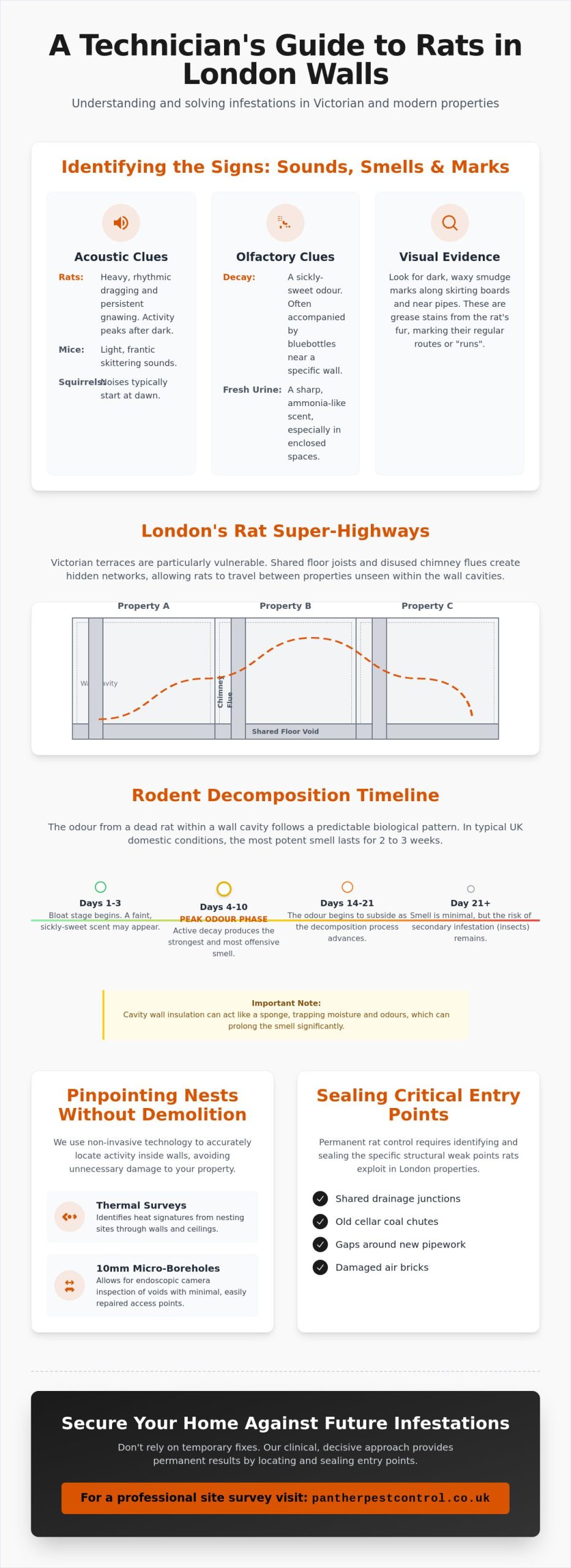
- Discover how to get rid of rats in walls London properties often harbour by identifying the “super-highways” created by shared floor voids and disused chimney flues.
- Understand the biological timeline of rodent decomposition, including why the peak odour phase typically persists for 14 to 21 days in standard UK domestic conditions.
- Find out how technicians use non-invasive thermal surveys and 10mm micro-boreholes to pinpoint nesting sites without resorting to unnecessary structural demolition.
- Identify the critical London-specific entry points, such as shared drainage junctions and old cellar coal chutes, that must be sealed to prevent recurring infestations.
Identifying the Signs of Rats in Your London Property’s Walls
Identifying rats within a property’s structure requires a clinical approach. You shouldn’t wait for a physical sighting to take action. In London, the specific architecture of Victorian terraces often amplifies the problem. Lath-and-plaster walls act like a drum, making the movements of a single rodent sound disproportionately loud. Many homeowners assume scratching in the ceiling means the attic is infested, but we often find the activity is actually within the wall cavity, echoing upwards. Knowing how to get rid of rats in walls London homes commonly suffer from begins with precise identification of these sensory cues.
To better understand how these pests navigate your home, watch this helpful video:
Visual evidence is just as critical as sound. Look for dark, waxy smudge marks along skirting boards or near floor-level gaps. These are grease stains from the rat’s fur, deposited as they follow established “runs” through the house. If you see these marks near a radiator pipe or a kitchen kickboard, it’s a definitive sign of frequent traffic. Professional rat control focuses on these high-traffic zones rather than placing traps randomly. We don’t guess where they are; we follow the physical evidence they leave behind.
Acoustic Clues: Is it a Rat, a Mouse, or a Squirrel?
Rats are heavy. Their movement is rhythmic and deliberate. You’ll hear them dragging tails or gnawing on wooden joists with a persistent, grinding sound. This differs from the light, frantic skittering of mice. Timing is the biggest giveaway. If the noise starts at dawn, you’re likely dealing with squirrels entering from the roof. If the house only comes alive after dark, it’s almost certainly the Brown rat (Rattus norvegicus).
The Olfactory Test: Distinguishing Fresh Infestations from Decay
Fresh urine has a sharp, ammonia-like bite. It’s particularly pungent in poorly ventilated London basements or under-stairs cupboards. Decay is different. It starts as a sickly-sweet scent during the “bloat” stage of decomposition. If you notice a sudden surge in bluebottles around a specific wall or floorboard, it’s a biological indicator of a dead rodent in the void. Don’t ignore these scents; they signal a timeline of decay that will only worsen without expert intervention.
Why London Architecture Influences How Rats Move Through Walls
London’s property landscape is a complex patchwork of eras. Each building style presents a unique set of structural vulnerabilities that rodents exploit. In a Victorian terrace, the floor joists often run continuously across multiple properties. This creates a hidden “super-highway” where a rat entering a basement in one house can travel the entire length of the block within the wall fabric. Understanding this connectivity is the first step in learning how to get rid of rats in walls London homeowners find so distressing.
Under current regulations, homeowners are responsible for Pest control on your property, but in London, the source is often external. We frequently see rats utilising disused chimney flues and old coal bunkers as direct entry points into the lath-and-plaster voids. These spaces are protected from the elements, providing the perfect environment for nesting. If you suspect an entry point is shared with a neighbour, a professional site survey is the only way to map the infestation accurately.
Modern cavity wall insulation also complicates the removal process. Whilst it keeps homes warm, it acts as a perfect nesting material and a literal odour sponge. When a rodent dies within glass wool or foam insulation, the material absorbs the fluids of decay, extending the duration of the foul smell. We often find that the only way to fully eliminate the scent is to remove the contaminated insulation entirely; a task that requires precision to avoid unnecessary structural damage.
Victorian Voids and Lath-and-Plaster Challenges
The gap between old brickwork and internal plaster is a primary nesting site. Rats utilise these voids to move vertically between floors without being seen. In older London plumbing systems, they may even gnaw through lead piping to reach water sources. We recently resolved a persistent issue in a Fulham flat where rats used shared utility voids to bypass traditional traps. By identifying the specific cellar entrance they were using, we stopped the cycle of re-entry.
Modern Developments: Integrated Appliances and Drylining
Modern builds aren’t immune. Dot-and-dab plasterboard creates a narrow but accessible space for juvenile rats to navigate. In high-density London flats, shared drainage systems mean one faulty non-return valve can affect multiple units. This is often how to get rid of rats in walls London residents in new builds must approach the problem; by looking at the shared infrastructure rather than just their own kitchen. Integrated units make access difficult, often requiring endoscopic cameras to locate the nesting site.
Dead Rat Smell in House: How Long Does the Odour Actually Last?
A dead rat smell typically persists for 14 to 21 days in standard UK conditions. This isn’t a mere discomfort; it’s a biological process that can render a property uninhabitable. If you’re currently researching how to get rid of rats in walls London technicians often find that the “waiting it out” approach fails. The odour frequently intensifies just when you think it’s finally beginning to fade.
The “Peak Odour” phase occurs when the carcass enters active decay. In London, this stage is often prolonged by high humidity in Victorian cellars or a complete lack of airflow in modern cavity voids. Without ventilation, the cloying scent of decomposition becomes trapped. It saturates nearby plasterboard and glass wool insulation. We recently dealt with a case in a Greenwich basement where the lack of air movement meant the smell was still potent after four weeks. We recommend professional dead animal removal to stop this saturation before the smell becomes a permanent fixture of your home’s fabric.
Addressing the smell is only half the battle. Truly knowing how to get rid of rats in walls London homes attract means dealing with the biological aftermath while simultaneously planning for permanent exclusion. Ignoring the source doesn’t just prolong the smell; it invites a host of secondary issues that can affect your health and property value.
The Five Biological Stages of Rodent Decomposition
Decomposition follows a predictable sequence. The Fresh and Bloat stages occur within the first 72 hours as internal gases like hydrogen sulphide and methane accumulate. This leads into Active Decay. This is the most nauseating period. The carcass loses significant mass and fluids, which often leak into the surrounding building materials. Finally, the remains reach Desiccation. This is the transition to a mummified state where the odour finally begins to fade. However, in damp London properties, this process can be delayed significantly.
Secondary Risks: Flies, Beetles, and Ectoparasites
A dead rodent is a biological magnet. Blowflies can locate a carcass behind a wall within minutes of death. This leads to maggots and a secondary fly infestation within your living space. There’s also a significant risk from ectoparasites. Fleas and mites will leave a dead host as soon as the body temperature drops. They seek human alternatives elsewhere in the house. Later, carpet beetles may infest the dried remains. These pests can eventually spread to your soft furnishings, carpets, and wardrobes.
Professional Detection: Locating Rats Without Unnecessary Demolition
Amateur advice often suggests cutting large holes in plasterboard to find the source of an odour. This is a destructive and often fruitless approach. In London’s complex property voids, smells drift through floorboards and disused flues, meaning the scent is rarely located directly above the carcass. Knowing how to get rid of rats in walls London technicians manage requires non-invasive technology to pinpoint the exact coordinates of activity or decay before any physical intervention occurs.
Our detection process follows a disciplined progression to protect your property’s structural integrity. We don’t guess; we verify. The process includes:
- Acoustic and thermal survey: We use high-sensitivity equipment to identify heat signatures from microbial activity or rhythmic scratching sounds.
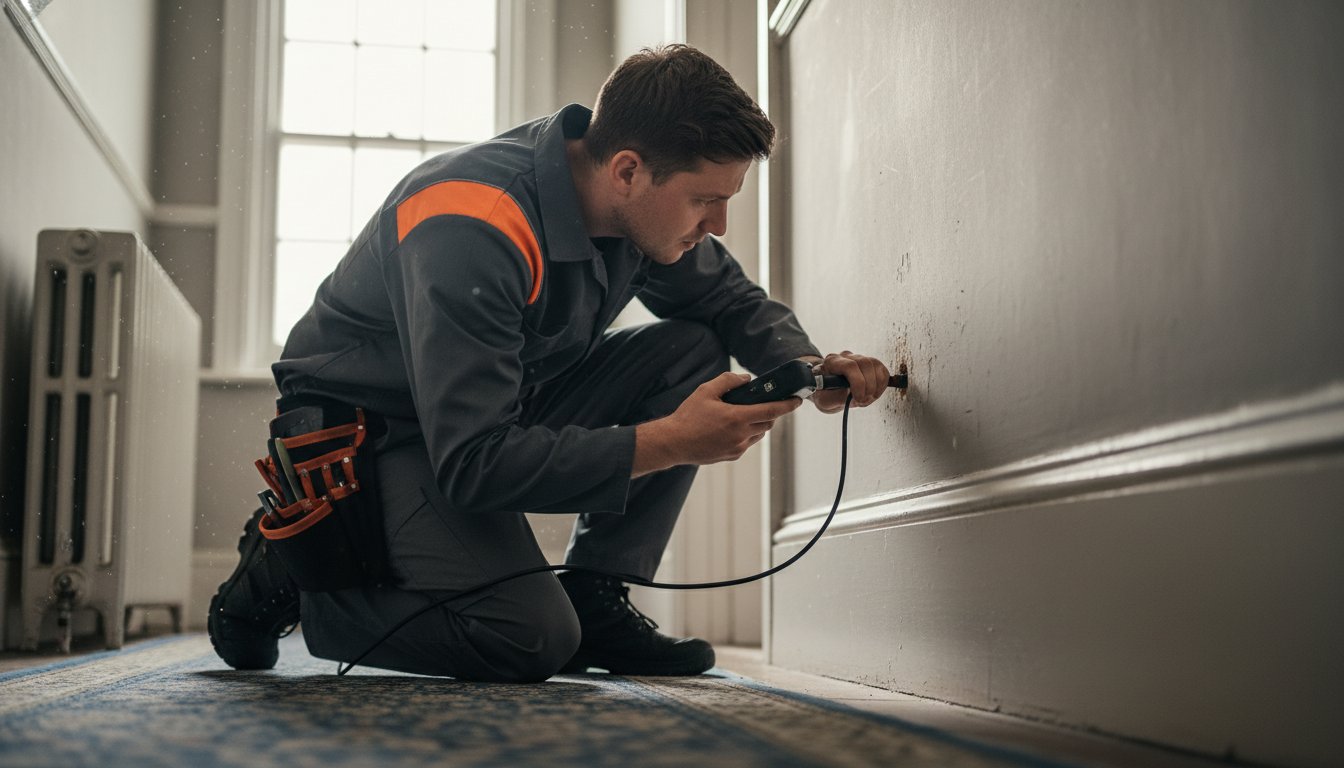
- Micro-boreholes: We drill discreet holes of less than 10mm to allow for endoscopic camera (borescope) inspection.
- Airflow analysis: By studying how air moves through your wall cavities, we ensure the extraction point is positioned directly over the source.
- Precision extraction: Once located, we remove the rodent with minimal disruption to the wall fabric.
- Sanitisation: We utilise ULV fogging to disperse antimicrobial agents that neutralise airborne bacteria and lingering scent particles.
If you suspect a rodent has died within your wall fabric, don’t resort to guesswork. You can book a professional inspection to locate and remove the source with surgical precision.
High-Tech Tools for the Modern Technician
Thermal imaging is a standard requirement for modern pest inspections. It identifies the heat signature of microbial activity within a carcass, which often shows as a distinct “hot spot” against a cold wall. Borescopes allow us to navigate Victorian wall cavities without removing historic lath and plaster. This technology is vital in London, where preserving original architectural features is as important as resolving the infestation. DIY “sniff tests” fail because they cannot account for how chimney stacks and floor voids redirect odours.
Neutralisation vs. Masking: The Professional Standard
Bleach and scented candles are temporary distractions that often create toxic fumes when mixed with the gases of decay. Professional results require enzymatic cleaners that break down organic molecules at the molecular level. For severe whole-house contamination, we may implement ozone treatments to oxidise odour-causing compounds. This clinical approach ensures the air is safe and fresh, rather than just heavily perfumed. We focus on total elimination of the biological footprint left behind by the infestation.
Permanent Rat Proofing: Sealing Your Home Against Future Infestations
Removing a rodent from a cavity is a temporary victory. If the structural breach remains, another individual will occupy the void within days. Identifying the primary entry point is far more critical than simply removing the current resident. This is the cornerstone of how to get rid of rats in walls London homeowners must understand to break the cycle of infestation. We often see homeowners rely on retail products that fail because they don’t address the shared structural defects common in the city’s terrace housing.
A “poison-first” approach in wall cavities is a professional failure. It almost guarantees the rodent will die in an inaccessible spot, leading to the nauseating timeline of decay we’ve already outlined. Instead, we focus on mechanical exclusion and targeted removal. Effective proofing often starts at ground level. You can read our detailed guide on how to stop rats climbing drainpipes to understand how external access leads to internal wall infestations.
London-specific proofing requires a focus on shared infrastructure. We frequently find that rats enter through old cellar coal chutes or defects in shared drainage junctions. These areas require industrial-grade materials rather than the flimsy expanding foam often used in amateur attempts. Our standard is to create a clinical barrier that rejects the possibility of re-entry.
The Trap vs. Poison Debate for Indoor Rats
We prioritise trapping for all indoor infestations. This ensures the carcass can be physically removed, preventing the cloying odours and secondary pest outbreaks discussed in previous sections. Using rodenticides inside walls is risky; there’s a significant danger of secondary poisoning for local London pets and urban wildlife if a weakened rat exits the property. To ensure accuracy, we use non-toxic tracking dust. This allows us to map the rat’s exact routes before we begin the rat control process, ensuring our traps are placed with surgical efficiency.
Long-Term Structural Proofing for London Houses
Permanent exclusion requires materials that resist the persistent gnawing of a determined rodent. We use stainless steel mesh and specialised sealants that are impervious to rat teeth. In boroughs like Camden and Croydon, we frequently find significant gaps around Victorian pipework or modern utility entries that have been poorly finished during renovations. These are direct invitations for pests. We also recommend the installation of non-return valves in shared London sewer systems. These valves allow waste to exit but prevent rats from swimming up the laterals and entering your wall cavities through the drainage network.
Restoring Safety and Silence to Your Property
Resolving a rodent infestation within your home’s structure requires more than just setting traps. It demands a clinical understanding of London’s interconnected architecture and the biological realities of decay. By focusing on non-destructive detection and permanent structural proofing, you eliminate the risk of lingering odours and recurring invasions. We’ve established that the key to how to get rid of rats in walls London residents trust is a combination of expert extraction and industrial-grade exclusion.
Our team brings over 10 years of experience specifically handling London’s complex Victorian properties. We utilise specialised non-destructive detection equipment to pinpoint issues without damaging your home’s fabric. With a 24/7 emergency response available across the M25 area, professional intervention is always accessible. You don’t have to manage the nauseating aftermath of an infestation alone.
Don’t let a hidden infestation compromise your home’s security or hygiene. You can request a professional rat removal and proofing quote in London to secure your property today. Quiet nights and a fresh, safe environment are well within reach.
Frequently Asked Questions
Can I just leave a dead rat in the wall to decompose naturally?
You shouldn’t leave a dead rodent to decompose because it creates a biological hazard within your home’s structure. A carcass attracts blowflies and carpet beetles that can quickly spread into your living spaces. The cloying odour will persist for at least three weeks and can permanently saturate porous building materials like plasterboard and insulation, requiring expensive replacement later.
Does the dead rat smell get worse in the summer or winter?
Decomposition accelerates significantly during the summer months. High temperatures increase bacterial activity and gas production within the carcass, making the scent more intense. Whilst winter temperatures slow the process, the high humidity found in London basements often prevents the remains from drying out. This causes the scent to linger much longer than it would in a dry environment.
Will bleach get rid of the dead rat smell behind my plasterboard?
Bleach is ineffective for neutralising the biological compounds of decay. It merely masks the odour temporarily and can react with decomposition gases to produce irritating fumes. Professional technicians avoid this shortcut. Instead, we use enzymatic cleaners to break down the organic molecules at the molecular level, ensuring the smell is eliminated rather than just covered up.
How do I know if the scratching in my wall is a rat or a mouse?
Scratching sounds are a reliable indicator of the species involved. Rats produce heavy, rhythmic thumping and grinding noises as they move through wall cavities. Mice create a much lighter, frantic skittering sound. If you’re investigating how to get rid of rats in walls London properties often amplify these sounds through old lath-and-plaster structures, making identification easier for an expert.
Can the smell of a dead rat actually make you sick?
The odour itself won’t cause disease, but the physical impact is often severe. Nausea, headaches, and loss of appetite are common responses to the cloying scent of decay. The real danger comes from secondary pests. Blowflies and mites will leave the dead host to seek new food sources in your kitchen or bedrooms, potentially spreading pathogens throughout your living environment.
What is the most effective way to find a dead rat without breaking the wall?
Thermal imaging is the most effective non-invasive detection method available. It identifies the heat signature produced by the microbial activity of decomposition. By using a borescope through a 10mm micro-borehole, we can visually confirm the location. This is the clinical standard for how to get rid of rats in walls London residents require to avoid unnecessary and costly structural damage.
Why has the smell returned after I thought the rat had dried out?
Odours often return during periods of high humidity or sudden rain. Moisture in the air rehydrates the desiccated remains or the contaminated insulation, causing the release of trapped scent molecules. This is why we often find that removing the rodent isn’t enough on its own. The surrounding nesting material and any contaminated glass wool must also be cleared to ensure a permanent fix.
Is it legal to use poison to kill rats in a wall cavity?
It’s legal to use rodenticides, but professional standards strictly favour trapping for indoor infestations. As of January 2026, new UK regulations require professional users to provide proof of competence for rodenticide use. Poisoning a rat inside a wall cavity almost guarantees it’ll die in an inaccessible spot. This creates a long-term odour problem that can render your rooms unusable for several weeks.

Al Joel is a practical writer and long-term property maintenance specialist focused on real-world pest control, home safety and prevention advice. His guides translate common warning signs into clear next steps for homeowners, tenants, landlords and property managers.His approach begins with correct identification. A sighting in one room may originate from a neighbouring flat, service riser, drainage, roof space, delivery or communal waste area. Al explains how to preserve useful evidence, reduce food and water sources, avoid spreading activity and choose proportionate treatment.What readers can expectClear identification clues and practical inspection stepsSafe preparation, cleaning and aftercare guidancePrevention advice for homes, flats and commercial premisesHonest guidance on when DIY is reasonable and when professional help is the smarter optionWhen professional help makes senseRepeated sightings, activity in several rooms, uncertain identification, vulnerable occupants or signs involving food, electrics and shared building routes deserve a professional inspection. A lasting solution normally combines targeted treatment with proofing, hygiene and follow-up monitoring.Explore the Pest Library, learn how treatment works, or request property-specific advice.