
What Do Bed Bug Bites Look Like? A Professional Identification Guide (2026)
Recent industry insights reveal a significant increase in bed bug activity across the UK between 2023 and 2024. This represents a substantial surge among common pests, with London alone experiencing a notable rise in cases. It’s exhausting to wake up with itchy red welts and wonder what do bed bug bites look like compared to a simple skin rash or a flea bite. You deserve certainty, not guesswork.
We understand the anxiety of a hidden infestation and the physical discomfort that follows. This guide will teach you to identify bed bug bites with clinical precision and distinguish them from other UK pests to reclaim your peace of mind. You’ll learn to map feeding patterns to harbourage areas, ensuring you get proper inspections, not quick fixes. We’ll preview the visual symptoms and the proven next steps for professional eradication to ensure the job is done properly, not temporarily.
Key Takeaways
- Identify the clinical anatomy of a bite, including the central punctum, to understand exactly what do bed bug bites look like on human skin.
- Recognise the “Breakfast, Lunch, and Dinner” linear feeding pattern that distinguishes these pests from random mosquito or flea bites.
- Understand the delayed reaction timeline to track when the infestation actually began, rather than relying on when the itch first appeared.
- Learn why physical evidence in your home is essential for a 100% diagnosis, ensuring proper treatment-not guesswork.
- Compare the itch profiles and symptoms of common UK pests to differentiate between a minor nuisance and a high-stakes crisis.
Visual Identification: The Anatomy of a Bed Bug Bite
A bed bug bite is a clinical event, not a random skin irritation. When these insects feed, they inject a complex cocktail of anticoagulant saliva to ensure a steady blood flow. This chemical interaction triggers a localised inflammatory response, resulting in a raised, red welt that is often mistaken for other pests. To truly understand what do bed bug bites look like, you must look for the central punctum. This tiny, dark spot at the very centre of the welt indicates the exact point where the skin was pierced. Identifying this mark provides clinical certainty, not guesswork.
On darker skin tones, the presentation changes significantly. Instead of bright red, the welts frequently appear dark brown or deep purple. Identifying these marks requires a trained eye to distinguish them from general dermatitis or hyperpigmentation. For a deeper look into the biological habits and physical traits of these pests, consult this comprehensive guide to bed bugs.
To better understand these physical markers and how they manifest on the body, watch this helpful video from Doctor O’Donovan:
Size, Colour, and Texture
Typical bites range from 2mm to 5mm in diameter. They possess a distinct firmness. If you press a mosquito bite, it often feels soft and fluid-filled. A bed bug welt feels resilient and dense under the finger. Fresh bites frequently exhibit a pale halo effect where the surrounding skin loses colour momentarily due to the initial swelling. This contrast helps distinguish them from the more uniform redness of a heat rash or an allergic reaction to fabric detergents.
Sensory Symptoms: Itching and Burning
The primary symptom is intense pruritus, or itching. This discomfort typically peaks in the early morning hours when the body’s natural cortisol levels are lower. Some individuals report a sharp burning sensation that precedes the physical appearance of the welt. However, visual checks alone are unreliable. Approximately 30% of people show zero skin reaction to bed bug saliva. This means an infestation can grow for weeks without a single visible bite, making professional detection-not just skin monitoring-vital for your safety. We focus on proper inspections, not just treating visible symptoms.
The “Breakfast, Lunch, and Dinner” Pattern
One of the most reliable ways to answer the question of what do bed bug bites look like is to examine the arrangement of the welts. Unlike the chaotic, scattered distribution of mosquito bites, bed bugs frequently feed in a distinct linear sequence. This is colloquially known as the “Breakfast, Lunch, and Dinner” pattern. It’s a result of the bug’s probing behaviour. If an insect is disturbed by your movement or fails to find a suitable capillary on the first attempt, it will withdraw and re-insert its mouthparts just a few millimetres further along. This creates a neat row of three or four bites that is almost pathognomonic for this specific pest.
These clusters typically form where your skin makes direct, sustained contact with the mattress or bedding. This is about biological necessity, not coincidence. For clinical guidance on identifying these symptoms and managing the irritation, the NHS guide to bed bug bites provides essential diagnostic criteria for UK residents. Recognising this pattern early is the difference between a minor nuisance and a full-scale crisis.
Common Body Locations for Bed Bug Bites
Bed bugs target exposed skin. They lack the specialized mouthparts required to bite through fabric, which distinguishes them from fleas or certain mites that often bite through socks or under clothing.
- Face and Neck: These are high-visibility areas often targeted first due to their proximity to the headboard.
- Arms and Hands: Particularly common if you sleep with your limbs outside the duvet.
- Waistlines: A frequent hotspot where pyjama elastic meets the skin, creating a tight entry point for the pest to feed undisturbed.
Why the Pattern Matters for Diagnosis
Professional technicians don’t just look at the skin; they map the bites to the room. A line of three or four welts pointing toward the top of the bed often leads directly to a harbourage in the headboard or a mattress seam. This is the hallmark of proper inspections, not guesswork. In a new infestation, you might only find one or two of these sequences. However, in established cases, the skin may show multiple overlapping clusters, indicating a high population density that requires immediate intervention. If you’ve identified these linear patterns on your skin, it’s time to speak directly to a technician to confirm the source before the population doubles. We provide clinical certainty, not speculation, ensuring your home is restored to safety.
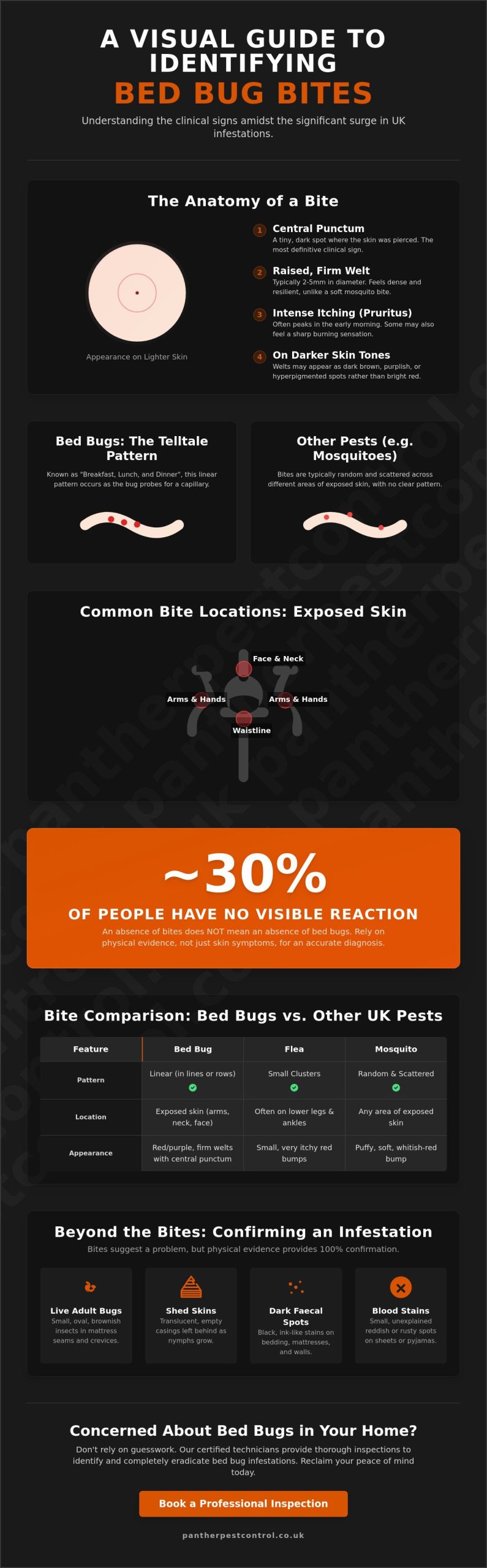
Bed Bug Bites vs Other Common UK Pests
Identifying what do bed bug bites look like requires a clinical process of elimination. You must distinguish true infestations from common UK bite mimics to avoid misdirected treatment. The itch profile serves as a primary diagnostic tool. Mosquitoes and midges typically cause an immediate itch. Bed bug bites often produce a delayed reaction, with welts appearing several days after the initial feed. We also encounter cases of Delusory Parasitosis, where the high-stakes stress of a suspected infestation creates the sensation of crawling skin. Proper inspections, not guesswork, are the only way to confirm a biological presence.
Bed Bugs vs Fleas: The Ankle Test
Flea bites are generally smaller than bed bug welts. They appear as tiny red dots and are heavily concentrated around the lower legs and ankles. A key differentiator is the halo. Flea bites often feature a very distinct, bright red ring around the central puncture point. Their behaviour is also distinct. Fleas bite throughout the day, whilst bed bugs are strictly nocturnal. If you’re being bitten on the ankles while sitting on the sofa during the afternoon, you likely need flea treatment, not bed bug eradication.
Bed Bugs vs Mosquitoes and Midges
Texture provides the best clue here. Mosquito bites are soft, puffy swellings that feel fluid-filled. Bed bug welts are hard, resilient, and dense. In London, midges and mosquitoes are seasonal nuisances that peak during warmer months. Bed bugs are a year-round threat that thrives in the consistent temperatures of modern central heating. Furthermore, mosquito bites are usually isolated and scattered randomly across the body. They don’t follow the linear “three-bite” sequence characteristic of a bed bug’s probing behaviour.
When It Isn’t a Bug: Hives and Skin Conditions
Sometimes the irritation isn’t caused by a pest. Heat rash, hives (urticaria), and contact dermatitis are common lookalikes that cause distress. To tell the difference, observe the spread. Rashes and hives usually manifest as a continuous sheet of redness or a cluster of tiny bumps that spread across a large area. Bites remain individual, distinct welts with a visible entry point. If the “bites” appear as a uniform red patch, we recommend seeing a pharmacist before booking an extermination. We focus on proper solutions, not unnecessary services. If the marks are individual and follow a pattern, our local technicians can provide a definitive diagnosis on-site.
Understanding the progression of a reaction is as critical as knowing what do bed bug bites look like during the initial feed. Most victims feel nothing when the insect is actually present because it injects a natural anaesthetic along with its anticoagulant saliva. This creates a deceptive period of calm. You might wake up in a London flat feeling perfectly fine, only to discover itchy welts appearing forty-eight or even seventy-two hours after the event. This delayed allergic response is why many people struggle to pinpoint exactly where they encountered the pests.
The physical evolution follows a predictable path. A bite typically starts as a small, flat red spot that is easily overlooked. Within hours, it transforms into a raised, inflammatory welt. If left undisturbed, these marks generally resolve within seven to fourteen days. However, scratching disrupts the skin barrier. This often leads to secondary bacterial infections like impetigo or cellulitis, which require clinical medical intervention, not just pest control.
The First 24 Hours
Many residents wake up with clear skin, only to see marks manifest by midday as the body begins to process the foreign proteins. You may notice a subtle tightness or a slight swelling in specific areas before the redness becomes obvious. Adhering to a strict no-scratch rule is vital during this window. Scratching at this stage increases the risk of permanent scarring and introduces bacteria into the puncture site. We recommend using a cold compress to reduce the initial inflammation properly.
Days 3 to 7: The Peak Reaction
This is when the pruritus reaches its maximum intensity. The welts become firm and may even develop small blisters in sensitive individuals. If you notice new clusters appearing every morning, it indicates a high-stakes, active infestation in your immediate environment. You can manage the discomfort with over-the-counter antihistamines or cooling creams to soothe the skin whilst the healing process continues. These are temporary reliefs, not long-term solutions.
The timeline of these reactions provides a clear roadmap of the infestation’s growth. A single line of bites suggests a recent arrival, while overlapping stages of healing and fresh welts signal an established population that is breeding nearby. If your timeline shows a recurring pattern of new marks, you need professional intervention to secure your home. Speak directly to a technician
Beyond the Bites: Confirming the Infestation in London
Bites are a biological indicator, not a definitive diagnosis. Whilst knowing what do bed bug bites look like helps you identify a potential problem, we never recommend starting a treatment cycle based on skin reactions alone. Clinical studies show that 30% of people don’t react at all, meaning the absence of bites doesn’t mean an absence of bugs. You need physical evidence to confirm the threat. Our “Panther Method” shifts the focus to hard evidence. We search for dark, ink-like faecal spotting and translucent, grain-like egg casings that often hide in the darkest recesses of your furniture.
In London, the high-density nature of terraced houses and shared apartment blocks means an infestation in one unit can quickly migrate through shared walls. Bed bugs utilise electrical conduits, skirting boards, and even plumbing gaps to move between properties. This makes the question of what do bed bug bites look like even more urgent for city dwellers, as the source could be next door. With a 30% rise in London cases recorded recently, the risk of picking up hitchhikers on the Tube or in shared workspaces is a reality of metropolitan life.
Where to Look: The Harbourage Hunt
Professional detection requires looking where amateur efforts fail. You must check the mattress seams and the tight crevices of the headboard where bugs congregate. In London’s compact living spaces, bed bugs frequently use electrical outlets and the gaps behind bedside pictures as primary transit routes. They aren’t just in the bed; they’re in the infrastructure.
- Mattress Seams: Check the piping for dark spots or cast skins.
- Electrical Outlets: Bugs are attracted to the warmth of the internal wiring.
- Commuter Gear: Inspect the seams of laptop bags and rucksacks used on public transport.
If you discover evidence in these locations, the situation requires professional intervention. Amateur sprays are a waste of time and money.
Additionally, maintaining the hygiene of your home’s textiles is a key part of property care. For those looking for expert assistance with their flooring and soft furnishings in the North West, Commercial Carpet Cleaners Stockport offers specialised carpet and upholstery cleaning services.
Eradication: Why “Done Properly” Matters
DIY sprays often fail because they act as a repellent rather than a total solution. They drive the insects deeper into wall voids, making the eventual extermination more complex and expensive. We offer Specialised Heat Treatment as the gold standard for London homes. It reaches into every crack and crevice, killing all life stages, including the resilient eggs, in a single day. This is about long-term results, not temporary fixes.
Our promise is direct. You can speak directly to a technician, not a call centre, to get immediate, expert advice tailored to your specific property. We provide clinical certainty to restore your home and your peace of mind. Don’t let a small problem become a high-stakes crisis. Book a professional bed bug inspection today to ensure the job is done properly.
Secure Your Home Against Infestation Today
Identifying what do bed bug bites look like is the first step toward regaining control of your environment. You now have the clinical tools to distinguish the linear feeding patterns from the random bites of seasonal midges or fleas. Remember that skin reactions are only part of the diagnostic story. You must verify the presence of faecal spotting and egg casings to confirm an active harbourage before professional treatment begins. This ensures long-term prevention, not quick fixes.
Panther Pest Control provides guaranteed heat treatment results, not guesswork. With 20,000+ jobs completed across London, we understand the high-stakes nature of a domestic infestation. We offer a 24/7 emergency response to ensure you get fast, professional intervention when you need it most. Don’t settle for amateur sprays that drive bugs deeper into your walls. Speak directly to a bed bug technician – get your home treated properly. You can sleep soundly tonight knowing your property is protected by a shield of expert intervention.
Frequently Asked Questions
Do bed bug bites always appear in a straight line?
Bed bug bites don’t always appear in a straight line, but a linear pattern is the most common feeding sequence. They often feed in a “Breakfast, Lunch, and Dinner” row as they probe for a suitable capillary. You might also see small, tight clusters if multiple insects feed in the same area. If the bites are scattered randomly across the body, they are more likely to be mosquitoes or midges.
How long do bed bug bites take to show up on skin?
Bites typically manifest within 24 to 72 hours, though they can take up to 14 days to appear in some individuals. This delay is due to the body’s unique immune response to the insect’s saliva. You might wake up with no symptoms and find the welts developing by midday. Because of this timeline, it’s difficult to pinpoint exactly where you were when the feeding occurred without a proper inspection.
Can you have bed bug bites but find no bugs?
It is common to have visible bites without seeing a single insect. Bed bugs are nocturnal and hide in microscopic crevices like mattress seams, electrical outlets, or behind skirting boards during the day. They only emerge when they sense the heat and carbon dioxide of a sleeping host. Finding no bugs doesn’t mean you’re safe; it means you need a professional to find the hidden harbourage.
What is the difference between a bed bug bite and a flea bite?
Flea bites are tiny red dots usually concentrated on the ankles and lower legs. They often have a bright red “halo” around the centre. Bed bug bites are larger, firmer welts that can appear anywhere on the upper body, including the face and neck. Fleas bite throughout the day, whilst bed bugs are strictly nocturnal feeders that prefer undisturbed skin contact.
Do bed bug bites have a hole in the middle?
Yes, bed bug bites feature a tiny dark spot in the centre known as a central punctum. This mark is the actual puncture point where the insect’s mouthparts pierced the skin. It distinguishes a bite from a general skin rash or hives, which don’t have a central entry point. Understanding what do bed bug bites look like requires looking for this specific clinical marker under good lighting.
What happens if you leave bed bug bites untreated?
Leaving bites untreated allows the infestation to grow exponentially. A single female can lay up to 500 eggs in her lifetime, leading to a massive population surge within weeks. Physically, excessive scratching can lead to secondary skin infections like impetigo or cellulitis. You need an extermination strategy that targets the source, not just creams to soothe the itching. Professional eradication is the only permanent solution.
Can bed bugs bite through leggings or pyjamas?
Bed bugs cannot bite through leggings, pyjamas, or other fabrics. They lack the mouthparts to pierce through material, unlike some species of mosquitoes. They will, however, crawl under loose clothing or target areas where the fabric meets the skin, such as waistlines or cuffs. Keeping skin covered can reduce the number of bites but won’t stop the infestation from spreading through your home.
Is it possible to be the only person in the house getting bitten?
Yes, it’s very common for only one person in a household to show symptoms. This doesn’t mean the bugs are only biting one person; it means the others aren’t reacting to the saliva. Approximately 30% of the population shows no visible marks after being bitten. This often creates a false sense of security while the infestation continues to build in shared walls or furniture.

Al Joel is a practical writer and long-term property maintenance specialist who focuses on real-world pest control, home safety, and prevention advice. His blog posts are written in a clear, no-nonsense style, based on hands-on experience rather than theory. Al’s goal is simple: to help homeowners make safe, informed decisions and know when DIY is reasonable and when professional help is the smarter option.
